Sarah Maria Beach, 45, faces up to a year in federal prison if convicted of assault
Beach, an American expat living in London, was on a flight to Salt Lake City
She allegedly threw coffee on passengers and assaulted a US Air Marshal
Beach also allegedly overturned a drink cart and ran up and down the aisle
Sarah Maria Beach, 45, an American expat living in London, faces misdemeanor assault charges which were filed in US district court in Utah on Thursday
A rowdy passenger aboard a Delta Airlines flight from London to Salt Lake City has been arrested for allegedly assaulting a US Air Marshal and throwing coffee on passengers.
Sarah Maria Beach, 45, an American expat living in London, faces misdemeanor assault charges which were filed in US district court in Utah on Thursday.
News of Beach’s arrest was reported by KSL.com.
Prosecutors have alleged that Beach threw coffee on passengers during the flight, overturned a drink cart, and ran up and down the aisle of the plane.
Flight attendants asked air marshals who were sitting in the back of the plane to help subdue Beach, according to the criminal complaint.
After Beach calmed down, she was seated next to one of the air marshals, who escorted her to the bathroom three times.
After she came out the third time, she allegedly jumped on the air marshal’s back and grabbed his head, neck, and jaw.
+2
Beach allegedly behaved rowdily while on a Delta Airlines flight from London to Salt Lake City. Delta planes are seen at Salt Lake City International Airport in this 2015 stock image
Another air marshal came to his colleague’s aid and pulled Beach off of her, the government alleges.
Beach was then handcuffed for the remainder of the flight.
Where is the collusion investigation on Christopher Steele a spy from Britain?
The former British spy who wrote the infamous dossier has been ordered to appear for a deposition in a lawsuit over the salacious document filed in the U.S.
A British court ordered Christopher Steele to testify about his role in compiling the dossier, which alleges that the Trump campaign colluded with the Russian government during the 2016 presidential campaign.
Steele’s report was funded by the Clinton campaign and Democratic National Committee. BuzzFeed News published the 35-page document in Jan. 2017.
Aleksej Gubarev, a Russian businessman named in the dossier, is suing BuzzFeed in Florida and Steele in London. The dossier claims that Gubarev was recruited as a Russian spy and that his web hosting companies were used to infiltrate the DNC’s computer systems.
Gubarev’s lawyers have tried for months to force the London-based Steele to provide a deposition for the lawsuit against BuzzFeed, which is being heard in federal court in Florida.
Steele has resisted the efforts to provide a deposition, arguing that Gubarev’s lawyers are attempting to use his deposition in the BuzzFeed case in order to collect information for use in the lawsuit pending against him in the U.K.
But a British judge sided against that argument.
A judge on the Queen’s Bench Division of the High Court in London ruled, “it is obvious that the author of the paragraph complained of in the Florida proceedings would be a relevant witness in defamation proceedings which are entirely based on the allegations in that paragraph, in a jurisdiction where the plaintiffs have to prove that the allegations are false,” Fox News reported.
Evan Fray-Witzer, a lawyer for Gubarev, praised the decision.
“We’re thrilled that the English Court has ordered Mr. Steele to sit for his deposition,” Fray-Witzer said. “It was always amazing to us that he could talk as freely as he has to reporters around the world about the dossier, yet refuse to sit for a deposition about the same topics.”
Fray-Witzer told The Daily Caller News Foundation a date has not been set for the deposition, but will likely be held within the next 4-6 weeks.
Fray-Witzer says that his team recently narrowed the scope of the information it sought from Steele. The former MI6 officer has asserted that his deposition could put dossier sources in danger.
Fray-Witzer says that his team has agreed not to ask Steele about his sources. He also says that Steele has chosen not to appeal the decision. “Buzzfeed published information about Mr. Gubarev and his companies that was unverified and untrue and they seem to be hoping to scuttle the deposition of the person most positioned to testify to those facts,” he told TheDCNF.
Gentleman’s Quarterly has proposed refashioning contemporary culture by unmooring it from the past, a feat that can be accomplished — in part — by updating lists of required reading to fit the modern Zeitgeist.
In their essay titled “21 Books You Don’t Have to Read Before You Die,” the editors of GQrecommend rewriting canons of Great Books by swapping out works that are hard to read, dangerously backward, or politically incorrect with more contemporary works that conform to the values and sensibilities of the modern cultural elite.
So, out with Tolkien’s Lord of the Rings, Hemingway’s The Old Man and the Sea, and of course, the Holy Bible, and in with chick-lit, inclusive language, edgy plots, and entertainment purged of traditional values or outdated suppositions about the human person, family, and society.
The Great Books are taken down in one fell swoop. “Some are racist and some are sexist, but most are just really, really boring,” we learn.
First among these “overrated books” is the Bible, for which the GQ editors reserve some particularly choice epithets. It is “repetitive, self-contradictory, sententious, foolish, and even at times ill-intentioned,” or, in a nutshell, “certainly not the finest thing that man has ever produced.”
As a substitute, why not read Agota Kristof’s The Notebook, the editors suggest, “a marvelous tale of two brothers who have to get along when things get rough.”
Their scorn extends well beyond the Good Book, however.
Pulling no punches, GQ says that the “cowboy mythos” of Lonesome Dove, for example, “with its rigid masculine emotional landscape, glorification of guns and destruction, and misogynistic gender roles, is a major factor in the degradation of America.”
Instead, we are told to read The Mountain Lion by Jean Stafford, which “acts in many ways as a strong rebuttal to all the old toxic western stereotypes we all need to explode.”
Salinger’s The Catcher in the Rye, on the other hand, “is without any literary merit whatsoever” and therefore should be replaced by Olivia, the Sapphic story of a British teenage girl who falls in love with her teacher Mademoiselle Julie.
Goodbye to All That, by Robert Graves, is definitely out, since it is “incredibly racist.” If one really must read about war, a more sanitized option is Dispatches by Michael Herr — we are told — which properly conveys “the cruelty and violence of modern warfare.”
And so, on and on.
One reads that Ernest Hemingway, with his “masculine bluster and clipped sentences” should give way to kinder, gentler writers. The Old Man and the Sea can be fruitfully substituted by The Summer Book, a “heartwarming” series of vignettes about a grandmother and granddaughter living on a remote Finnish island that “teaches us what it is to be in sync with the world.”
The Adventures of Huckleberry Finn gets the axe, of course (“Mark Twain was a racist”), as do The Bible, Henry James’ The Ambassadors, Jonathan Swift’s Gulliver’s Travels, and Bram Stoker’s Dracula. Try reading instead Mary Gaitskill’s Veronica, we are told, “in which emotions are so present and sensory they almost hold a physical weight.”
The exercise seems aimed primarily at avoiding contact with antiquated beliefs, racist language, and sexist assumptions.
In keeping with similar crusades on college campuses, it also seeks to bring in many more female writers, which GQ seems to think especially necessary for domesticating its predominantly male readership. Of its original list of 21 “required” works, not one is written by a woman. The new list, on the contrary, is dominated by women authors.
It is also noteworthy than its original list, GQ includes not a single volume from antiquity or even the Renaissance. Unlike the Great Books, here there is no Homer, no Plato, no Greek drama, no Virgil, no Dante, no Cervantes, and no Shakespeare.
Of course, different strokes for different folks. Everyone interested in literature has his own list of favorites that merit wider circulation as well as a similar list of “highly acclaimed” works that could just as well be forgotten. The core of the GQ proposal, however, is the surgical excision of books that serve to keep traditional values alive.
As simple as it is straightforward, GQ’s plan follows the tried-and-true political strategy of Antonio Gramsci, the Italian communist mastermind who explained in great detail how to overcome a “cultural hegemony” by replacing it with a new one (counter-hegemony).
According to Gramsci, society can only be changed by changing culture, and this can only be accomplished by developing a new cultural hegemony, which is necessarily rooted in folklore, popular culture, and religion.
The brave new world that the cultural left wishes to establish cannot come about as long as “folklore” (which includes art, literature, history, and other sources of national identity) remains rooted in the ideas and values of the Judeo-Christian West.
Only when a new set of values has been adopted and assimilated as a “commonsensical world view” to which any thinking person is expected to spontaneously adhere, can we say that the cultural hegemony has been successfully changed.
The original collection called The Great Books of the Western World, brainchild of Robert Hutchins and Mortimer Adler of the University of Chicago, was presented at a gala party in the Waldorf-Astoria Hotel in New York City, on April 15, 1952.
In his speech, Robert Hutchins, president of the University of Chicago, spoke glowingly of the project, underscoring its utility for the preservation of the culture of the west.
“This is more than a set of books, and more than a liberal education,” he said. “Great Books of the Western World is an act of piety. Here are the sources of our being. Here is our heritage. This is the West. This is its meaning for mankind.”
GQ’s proposal can only be viewed in these terms. It is not about suggesting more “entertaining” literature. It is about changing the cultural hegemony for the generations to come.
Idiots wasting taxpayer money on fake Climate Change.
Los Angeles officials are going forward with a $40,000-a-mile program to coat public streets to fight climate change, despite the city’s many financial challenges — including a $73 million budget shortfall for dealing with the ever-expanding homeless population.
The program uses a light-colored sealant to cover the streets, which decreases the pavement temperature of so-called “heat-islands,” according to media reports.
The LA Street Services began rolling out the project last May, which preliminary testing shows has reduced the temperature of roadways by up to 10 degrees.
The project involves applying a light gray coating of the product CoolSeal, made by the company GuardTop.
Los Angeles painting city streets white in bid to combat climate change
California officials are hoping their latest attempt to stem the rising tides of climate change leads to a more socially conscious — and cooler — summer.
“CoolSeal is applied like conventional sealcoats to asphalt surfaces to protect and maintain the quality and longevity of the surface,” according to the company website. “While most cool pavements on the market are polymer based, CoolSeal is a water-based, asphalt emulsion.”
advertisement
Last year, the L.A. Daily Newsreported on the high cost of the project — and that local officials approved it nonetheless.
The morning temperature of the black asphalt in the middle of a nearby intersection read 93 degrees. The new light gray surface on Jordan Avenue read a cool 70 — on what would turn out to be the first heat wave of the year.
“It’s awesome. It’s very cool — both literally and figuratively,” exclaimed Councilman Bob Blumenfield, whose Los Angeles district includes Canoga Park, squinting into the laser handheld thermometer. “We are trying to control ‘the heat island effect’ ” — or hotter temperatures caused by urban sprawl.
“The downside: we won’t be able to fry eggs on the streets,” Blumenfield said.
Los Angeles painting city streets white in bid to combat climate change
California officials are hoping their latest attempt to stem the rising tides of climate change leads to a more socially conscious — and cooler — summer.
Los Angeles Mayor Eric Garcetti, who is eyeing a run for the White House in 2020, has embraced the program “as part of an overall plan to reduce greenhouse gas emissions in the city by 45 percent below 1990 levels by 2025,” according to Fox News.
And environmental activists are praising L.A.’s street-sealing project.
“Advocates are confident that advances in asphalt technology will drive down the cost,” Mother Nature Network reported on Sunday.
“There’s also the related economic benefits to consider: in once-sweltering neighborhoods where streets are now painted white, residents will be less likely to crank the air conditioning on full blast, leading to significant savings on energy bills and decreased emissions,” the website reported.
“What’s more, the highly reflective nature of white-coated asphalt means that street lighting doesn’t have to kick in quite as early in the evening, saving additional energy.”
Supreme Court Rules To Protect Illegal Immigrants That Commit Felonies.
The U.S. Supreme Court struck down a provision of federal law Tuesday that allows the deportation of foreign nationals convicted of certain felonies.
Justice Neil Gorsuch joined with the court’s four liberals to strike down the law, in keeping with longstanding conservative anxieties about sweeping and imprecise grants of power to bureaucrats and regulators.
Justice Elena Kagan wrote the opinion for a five-member majority.
At issue in the case was a provision of the Immigration and Nationality Act (INA) that permits the deportation of any alien convicted of an aggravated felony. The law lists a number of convictions that qualify as “aggravated felonies,” then includes a catchall provision for “any other offense that is a felony and that, by its nature, involves a substantial risk that physical force against the person or property of another may be used in the course of committing the offense.”
James Dimaya, a lawful permanent resident, was slated for deportation to the Philippines following two convictions for first-degree burglaries. An immigration judge ordered his removal under the INA’s catchall provision, as first-degree burglary does not appear on the list of qualifying offenses. In turn, Dimaya challenged the provision, arguing it is unconstitutionally vague.
In a 2015 decision called Johnson v. U.S., the high court struck down as unlawfully vague a section of the Armed Career Criminal Act (ACCA) that defined a “violent felony” as, among other things, “conduct that presents a serious potential risk of physical injury to another.” Since then, litigants have brought a number of vagueness challenges to similar provisions of federal law.
The late Justice Antonin Scalia wrote the Johnson decision.
Dimaya argued the catchall section of the INA was substantially similar to the statute the court overturned in Johnson. The 9th U.S. Circuit Court of Appeals agreed, prompting the U.S. Department of Justice’s (DOJ) appeal to the Supreme Court. The DOJ argued the 9th Circuit’s review of the statute was excessive, since civil laws are only considered vague if they are “unintelligible.” Deportation proceedings are civil, not criminal matters.
In her opinion for the court, Kagan rejected that argument, finding the grave nature of deportation warrants heavy judicial scrutiny. She then explained the INA’s catchall provision has precisely the same elements as the unconstitutionally vague section of the ACCA, minor linguistic differences notwithstanding.
“Johnson is a straightforward decision, with equally straightforward application here,” she wrote, elsewhere noting the statute “invited arbitrary enforcement, and failed to provide fair notice.”
Gorsuch wrote a separate opinion concurring in the judgment, in which he argued vagueness challenges to civil laws should be treated as seriously as challenges to criminal laws. Many civil penalties — and not just deportation — are in his view so sweeping that courts should police aggressively for vagueness, and abandon the “unintelligible” standard currently in use.
“Grave as that penalty may be, I cannot see why we would single it out for special treatment when (again) so many civil laws today impose so many similarly severe sanctions,” he wrote. Such sanctions include “confiscatory rather than compensatory fines, forfeiture provisions that allow homes to be taken, remedies that strip persons of their professional licenses and livelihoods, and the power to commit persons against their will indefinitely.”
His opinion largely tracks the growing distrust in conservative legal circles of draconian penalties assessed through administrative processes, and is part of a growing campaign to challenge economic regulations on vagueness grounds.
Chief Justice John Roberts wrote the primary dissent, joined by Justices Anthony Kennedy, Clarence Thomas, and Samuel Alito.
The Justice Department said Congress should quickly amend the INA to ensure a wider range of criminal convictions qualify for deportation.
“We call on Congress to close criminal alien loopholes to ensure that criminal aliens who commit those crimes—for example, burglary in many states, drug trafficking in Florida, and even sexual abuse of a minor in New Jersey—are not able to avoid the consequences that should come with breaking our nation’s laws,” Justice Department spokesman Devin O’Malley said after the ruling.
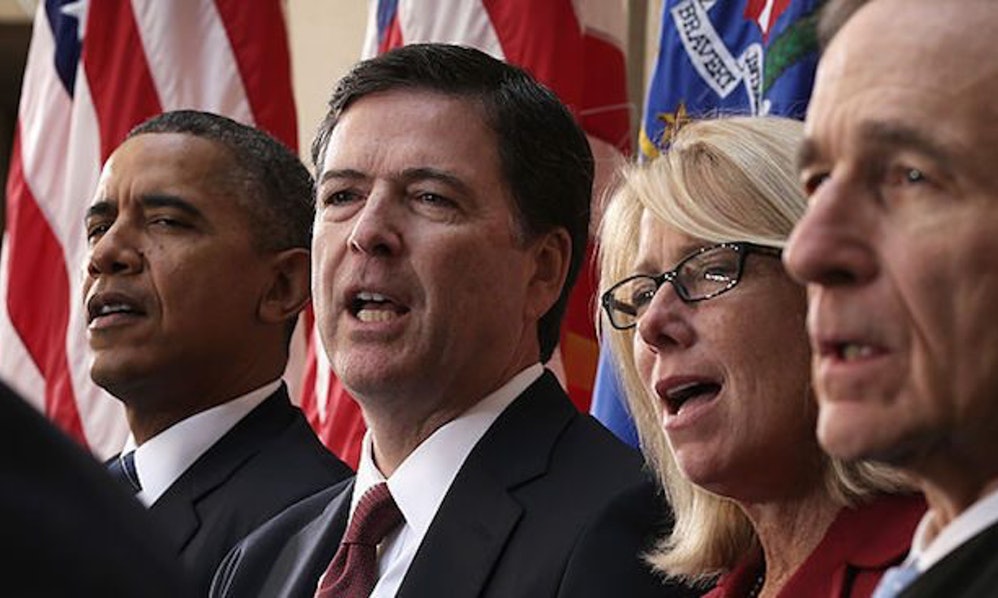
During an interview with ABC’s George Stephanopoulos, former FBI Director James Comey’s wife, Patrice, confessed that she supported Hillary Clinton and was “devastated” when Donald Trump won.
“I wanted a woman president really badly, and I supported Hillary Clinton,” Patrice Failor Comey told Stephanopoulos. “A lot of my friends worked for her. And I was devastated when she lost.”
James Comey admitted that his wife and girls all took part in the Women’s March in response to Donald Trump’s election.
“My wife and girls marched in the Women’s March, the day after President Trump’s inauguration,” he said. “At least my four daughters — probably all five of my kids, wanted Hillary Clinton to be the first woman president. I know my amazing spouse did.”