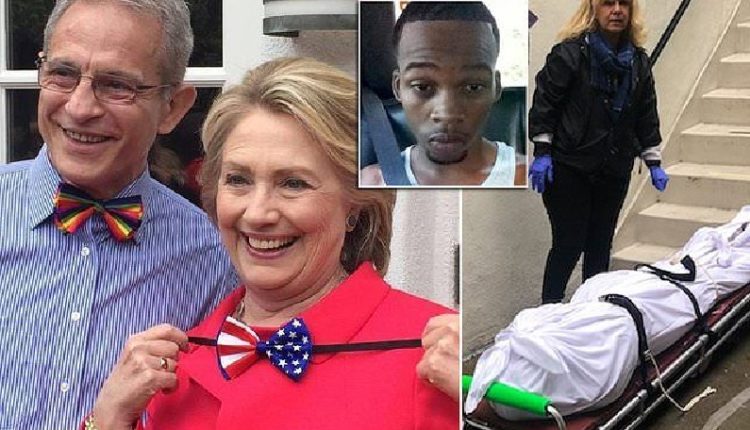
Buck, a white man in his 60s, was investigated previously by authorities after the death of Gemmel Moore, who died of a methamphetamine overdose in Buck’s home in July 2017. Since Moore’s death was classified as an accidental overdose, numerous young black gay men have alleged that Buck has a fetish for shooting drugs into black men he picks up off the street or on hookup sites. Moore had written about Buck injecting him with dangerous drugs before his death.
“I’ve become addicted to drugs and the worst one at that,” Moore wrote in his journal in December 2016. “Ed Buck is the one to thank. He gave me my first injection of crystal meth.”
Buck claims he’s not responsible for Moore’s death and did not furnish him with drugs. The Los Angeles County District Attorney declined to file charges against Buck, saying there was “insufficient evidence.”
The name of the person who died in Buck’s home in the early hours of Monday has not been released. Wehoville described him as a young African-American man and featured a picture of a body being removed on a gurney.
Community activists like Jasmyne Cannick have accused Los Angeles officials of declining to prosecute Buck in 2017 thanks to his contributions to powerful politicians such as Hillary Clinton, California Gov. Jerry Brown, L.A. Mayor Eric Garcetti, and numerous West Hollywood City Council members. Cannick is organizing a vigil and rally for tonight in front of Buck’s home, at 1234 Laurel Ave.
“City Council members John D’Amico and Lindsey Horvath have reached out to City Manager Paul Arevalo, asking him to request that newly elected Sheriff Alex Villanueva put priority on investigating [the young man’s] death,” Wehoville reports. “Councilmember Lauren Meister also has pressed for the homicide division to investigate.”
Buck’s attorney, Seymour Amster, characterized the death today as an accidental overdose and said Buck is cooperating with investigators. “From what I know, it was an old friend who died of an accidental overdose, and, unfortunately, we believe that the substance was ingested at some place other than the apartment,” Amster told the Los Angeles Times. “The person came over intoxicated.”
“He’s shaken up,” Amster said of Buck. “All indications are he had nothing to do with this tragedy.”
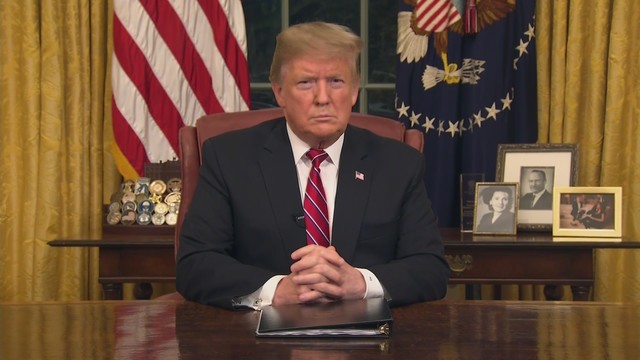
Left-wing Hollywood celebrities could not contain their urge to attack President Donald Trump Tuesday after his televised Oval Office address to the nation on border security.
In his first Oval Office address, President Trump told the nation, “Our Southern Border is a pipeline for vast quantities of illegal drugs – including meth, heroin, cocaine and fentanyl.”
“Every week, 300 of our citizens are killed by heroin alone – 90 percent of which floods across from our Southern Border. More Americans will die from drugs this year than were killed in the entire Vietnam War,” he said in part.
House Democrats pass plan to re-open government without funding Trump’s border wall
“This entire Trump speech has the cadence of a Wheel Of Fortune contestant solving the puzzle,” Family Guy creator Seth MacFarlane said in a social media post.
Seth MacFarlane
✔
@SethMacFarlane
This entire Trump speech has the cadence of a Wheel Of Fortune contestant solving the puzzle.
23.7K
9:13 PM – Jan 8, 2019
Twitter Ads info and privacy
3,759 people are talking about this
Twitter Ads info and privacy
“I’m not watching how’s the stunted reading and nose breathing,” comedian Sarah Silverman asked.
Sarah Silverman
✔
@SarahKSilverman
I’m not watching how’s the stunted reading and nose breathing
14.9K
9:12 PM – Jan 8, 2019
Twitter Ads info and privacy
2,223 people are talking about this
Twitter Ads info and privacy
Michael Moore fumed, “Trump, live now, railing against immigrants while sitting beside the photo of his immigrant mother. Shame.”
Of course, there is nothing contradictory about being against illegal immigration while championing legal immigration.
View image on Twitter
View image on Twitter
Michael Moore
✔
@MMFlint
Trump, live now, railing against immigrants while sitting beside the photo of his immigrant mother. Shame.
11.8K
9:06 PM – Jan 8, 2019
4,428 people are talking about this
Twitter Ads info and privacy
“Trump was grooming hard tonight. Hitler-Ian rhetoric. Wake up. Fight back or sit down Democrats,” said actress and #MeToo activist Rose McGowan.
rose mcgowan
✔
@rosemcgowan
Trump was grooming hard tonight. Hitler-Ian rhetoric. Wake up. Fight back or sit down Democrats
772
9:23 PM – Jan 8, 2019
Twitter Ads info and privacy
517 people are talking about this
Twitter Ads info and privacy
“munchausensbyproxy We’re living it every day. It might be called something else; a person holds an entire nation hostage so that they will pay attention to him. What is that called?? Anyone??” Bette Midler ranted.
Bette Midler
✔
@BetteMidler
#munchausensbyproxy We’re living it every day. It might be called something else; a person holds an entire nation hostage so that they will pay attention to him. What is that called?? Anyone??
11.9K
9:53 PM – Jan 8, 2019
Twitter Ads info and privacy
3,999 people are talking about this
Twitter Ads info and privacy
TBS host and immigration activist Samantha Bee urged her followers not to watch President Trump’s speech, but to instead watch clips of Christmas immigration special on Youtube.
Full Frontal
✔
@FullFrontalSamB
· 12h
Instead of listening to a bunch of lies about the border, maybe watch this instead: https://youtu.be/JFIGtdtaRtw #BoycottTrumpPrimeTime
YouTube @YouTube
Full Frontal
✔
@FullFrontalSamB
Or this!https://youtu.be/iL1EyLolFUk
100
9:01 PM – Jan 8, 2019
Twitter Ads info and privacy
YouTube @YouTube
21 people are talking about this
Twitter Ads info and privacy
She also promoted Kids in Need of Defense (KIND), a group that helps migrants in the legal system.
Some celebrities didn’t even need to hear Trump’s address before they made up their minds — hours before Trump spoke, Hollywood stars were already in full meltdown mode.
Check out all the Hollywood hysteria below.
Cher
✔
@cher
trump HAD 2 YRS 2 LIE WOLF, ALL BRANCHES Of GOV,&
TOTAL CORRUPT POWER☠️
WHERE WAS HIS CRISIS THEN.
WHAT HUMANITARIAN CRISIS IS HE SPEAKING OF,THE ONE WHERE HE RIPPED BABIES FROM MOMS ARMS,&⛓THEM,OR WHERE HIS ADMINISTRATION KILLED 2
7YRS OLD‼️HE HAS NO❤️ #ShutdownStories
5,708
10:13 PM – Jan 8, 2019
Twitter Ads info and privacy
1,261 people are talking about this
Twitter Ads info and privacy
Alyssa Milano
✔
@Alyssa_Milano
Straight lies from the Oval are nothing new. What is new is that @realdonaldtrump is losing base support, and fast, as his failures pile up. @speakerpelosi and @senschumer spoke truth to faux power as they pulled at the threads of an unraveling administration.
18.2K
10:00 PM – Jan 8, 2019
Twitter Ads info and privacy
6,520 people are talking about this
Twitter Ads info and privacy
Jeffrey Wright
✔
@jfreewright
Is this buck-passing, malevolent, empty fat suit really trying to paint himself as empathetic?
1,236
9:10 PM – Jan 8, 2019
Twitter Ads info and privacy
184 people are talking about this
Twitter Ads info and privacy
View image on Twitter
View image on Twitter
Kathy Griffin
✔
@kathygriffin
As Trump spouts off with his BS…a reminder of when he had this conversation about the wall with the then President of Mexico. We know what was said thanks to leaked transcripts published in the Washington Post. https://www.washingtonpost.com/graphics/2017/politics/australia-mexico-transcripts/?noredirect=on&utm_term=.57421b1e7df4 …
637
9:13 PM – Jan 8, 2019
296 people are talking about this
Twitter Ads info and privacy
Michael Ian Black
✔
@michaelianblack
I may not always agree with him, but I have to admit that nobody slurs his lies better than Trump.
1,463
9:49 PM – Jan 8, 2019
Twitter Ads info and privacy
133 people are talking about this
Twitter Ads info and privacy
Mikel Jollett
✔
@Mikel_Jollett
No state of emergency declared. No new policy. Just a bunch of lies about process and racist scare stories.
Good job, networks.
5,979
9:17 PM – Jan 8, 2019
Twitter Ads info and privacy
1,277 people are talking about this
Twitter Ads info and privacy
John Leguizamo
✔
@JohnLeguizamo
I believe trump is shutting down government to slow down or stop investigation and indictments and eventual prosecution!
1,217
9:30 PM – Jan 8, 2019
Twitter Ads info and privacy
294 people are talking about this
Twitter Ads info and privacy
George Takei
✔
@GeorgeTakei
There. Is. No. Crisis.
7,390
9:17 PM – Jan 8, 2019
Twitter Ads info and privacy
1,443 people are talking about this
Twitter Ads info and privacy
Kumail Nanjiani
✔
@kumailn
Don’t watch it.
15.7K
9:10 PM – Jan 8, 2019
Twitter Ads info and privacy
1,299 people are talking about this
Twitter Ads info and privacy
Mia Farrow
✔
@MiaFarrow
FACT: Immigrants are less likely to commit crimes than native-born Americans.
260
9:12 PM – Jan 8, 2019
Twitter Ads info and privacy
147 people are talking about this
I thought Muslim women where not suppose to use profanity. America will not be happy until muslims take over.
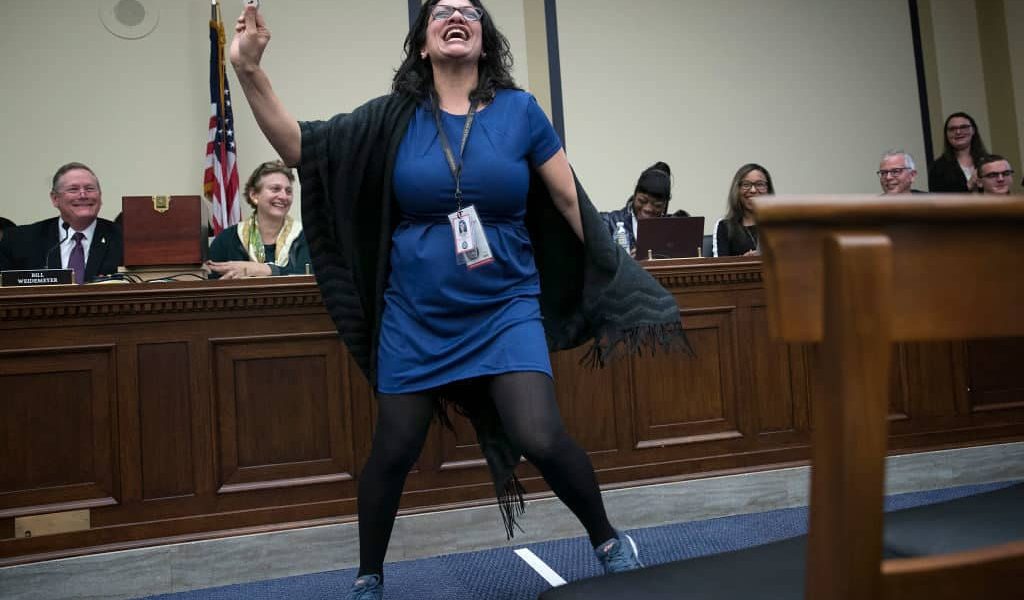
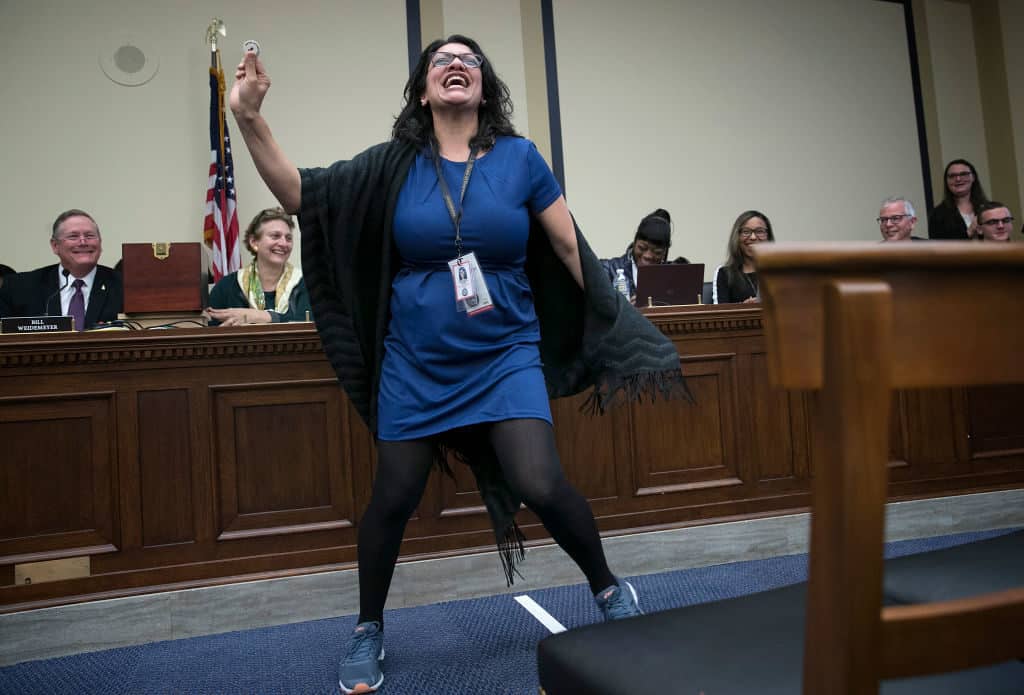
Just hours after being sworn into Congress on Thursday, Democratic Michigan Rep. Rashida Tlaib promised to go after President Donald Trump, telling a group of left-wing supporters she would help Democrats “impeach the motherf****r.”
Tlaib, who was one of two Muslim women sworn into Congress, made the remarks at a rally held by MoveOn near Capitol Hill, according to reporters at the event.
Barstool News Network
@BarstoolNewsN
We got congresspeople out here calling the president a mother fucker
340
11:02 PM – Jan 3, 2019
207 people are talking about this
Twitter Ads info and privacy
Daniel Marans
✔
@danielmarans
Rashida Tlaib to a crowd of cheering supporters in DC: “We’re gonna go in there and impeach the motherfucker!”
1,169
10:23 PM – Jan 3, 2019
Twitter Ads info and privacy
302 people are talking about this
Twitter Ads info and privacy
Dave Weigel
✔
@daveweigel
Raucous reception for @RashidaTlaib at MoveOn reception near the Hill. Her closing remarks: “We’re gonna impeach the motherfucker.”
14.6K
10:23 PM – Jan 3, 2019
Twitter Ads info and privacy
3,635 people are talking about this
Twitter Ads info and privacy
Tlaib’s remarks show just how eager some Democrats are to remove Trump from office. Earlier on Thursday, just after Democrats officially took over the House, Democratic California Rep. Brad Sherman reintroduced articles of impeachment against Trump.
Democratic leaders shied away from impeachment talk leading up to Thursday’s handover. Speaker of the House Nancy Pelosi has not committed to impeachment, saying it would be divisive for the country. In an interview that aired Thursday morning, Pelosi said she will withhold a decision until special counsel Robert Mueller issues his report in the Russia investigation.
WASHINGTON, DC – NOVEMBER 07: House Minority Leader Nancy Pelosi (D-CA) holds a news conference following the 2018 midterm elections at the Capitol Building on November 7, 2018 in Washington, DC. Republicans kept the Senate majority but lost control of the House to the Democrats.
Get ready America because the takeover has began.
“Well we have to wait and see what happens with the Mueller report. We shouldn’t be impeaching for a political reason, and we shouldn’t avoid impeachment for a political reason. We just have to see how it comes,” Pelosi said. (RELATED: Rashida Tlaib Takes Oath Of Office Using Thomas Jefferson’s Quran)
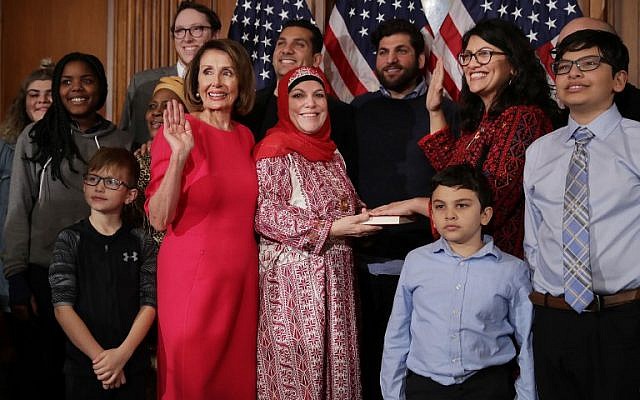
Tlaib, the first Palestinian-American woman to be elected to Congress, made news earlier in the day when she took her oath of office using Thomas Jefferson’s Quran.
This idiot thinks he can impeach Trump for firing James Comey.
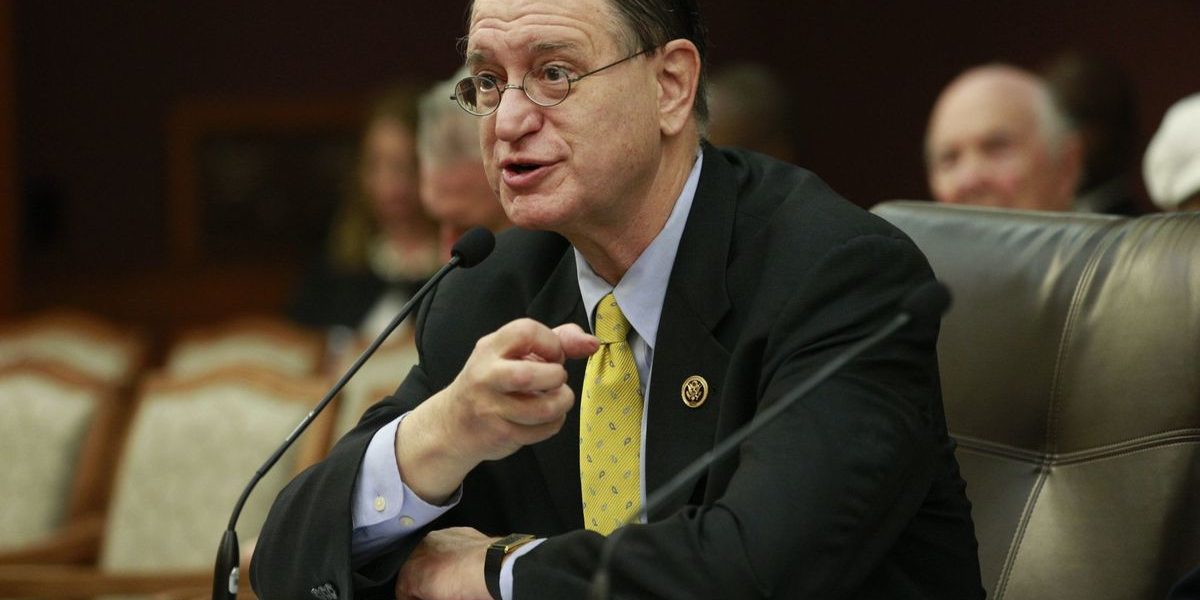
Rep. Brad Sherman (D-CA) plans to introduce articles of impeachment against President Donald Trump on Thursday — the first day that Democrats control the majority in the U.S. House of Representatives.
Sherman first filed such articles in 2017, though they had no chance of going anywhere in the Republican-controlled House. Other Democrats joined his effort over the months that followed, without much effect.
Sherman, who was until recently considered a “moderate,” is close to the Bill and Hillary Clinton wing of the Democratic Party. He backed Hillary Clinton over Sen. Bernie Sanders (I-VT) in the Democratic presidential primary in 2016, and has adopted hawkish foreign policy positions in the past. But in the two years since Trump won the presidency, Sherman has — like some other “moderates” — become obsessed with removing Trump.
Rep. Brad Sherman plans to introduce articles of impeachment against President Trump on Thursday, the first day of Democratic control of the House.
Sherman (D-Northridge) is reintroducing a measure that he first rolled out in 2017. But this year it carries more political significance: The decision of whether to act on it rests with Democrats — not Trump’s Republican allies.
Sherman’s articles of impeachment accuse Trump of obstructing justice by firing former FBI Director James B. Comey, among other wrongdoing.
“There is no reason it shouldn’t be before the Congress,” Sherman said. “Every day, Donald Trump shows that leaving the White House would be good for our country.”
Incoming Speaker of the House Nancy Pelosi (D-CA) has tried to keep impeachment at bay, knowing that it would provoke public opposition. However, left-wing Democrats like Tom Steyer — who may be running for president in 2020 — have insisted that impeachment should be the top priority of the new Democratic majority in the House.
Any impeachment would have to be confirmed by the Senate in a two-thirds majority to convict and remove Trump — something that is very unlikely to happen, given that Republicans increased their majority in the 2018 elections.
Update: Newly-elected Rep. Rashida Tlaib (D-MI) also endorsed impeaching Trump on her first day in office, according toThe Nation, which described Tlaib as calling for “immediate steps” to remove the president from the White House.
“Each passing day brings more pain for the people most directly hurt by this president, and these are days we simply cannot get back. The time for impeachment proceedings is now,” Rep. Tlaib declared.
Clinton also fired his FBI chief — but he wasn’t being investigated by the FBI at the time
James Comey has made history, but not in the way he would have wanted: In the 82-year history of the modern FBI, he’s only the second of the nation’s top law enforcement officials to be fired by a sitting president.
The first was FBI Director William Sessions, whom President Bill Clinton fired in 1993 amid allegations of ethics violations. Sessions (no relation to Trump’s embattled attorney general, Jeff Sessions) was just six years into his 10-year term, and the firing helped set the stage for what became years of tensions between Clinton and the FBI.
But Donald Trump isn’t Bill Clinton, and Jim Comey isn’t Bill Sessions. Clinton only fired the FBI chief after a several months-long investigation that concluded before Clinton even took office.That deep dive into Sessions’s actionsresulted in a 161-page report chronicling, in meticulous detail, a pattern of alleged ethical violations. More importantly, Clinton — unlikeTrump — wasn’t under active FBI investigation when he decided to oust Sessions.
By contrast, Trump has fired the man leading a criminal investigation into the president’s own campaign. The allegations — that the Trump team actively colluded with Russia to help Trump win the White House — couldn’t be weightier. Trump’s move could impede the FBI probe in the short term, but it’s almost certain to accelerate a process that could prematurely end his presidency.
“The FBI has gone after presidents before,” says Tim Weiner, a Pulitzer Prize-winning journalist and historian, pointing to the bureau’s probes of Richard Nixon during Watergate and Ronald Reagan during the Iran-Contra scandal. “But never … has a president dismissed an FBI director when members of the president’s administration and members of the president’s campaign team were under investigation for colluding with a foreign power.”
Understanding why Trump’s move has sparked such an uproar means taking a closer look at the Sessions firing and its similarities to the Comey ouster — and, more importantly, its differences.
Donald Trump isn’t the first president to fire an FBI director
The year was 1993; the newly minted president was William Jefferson Clinton. (The country was months, even years, away from when Clinton himself would be under investigation for a real estate scandal in Arkansas and, later, lying about his affair with Monica Lewinsky.)
The FBI director was William Sessions, a federal judge put in charge of the FBI by Ronald Reagan. Sessions was six years into his 10-year term, and he was a thorn in the side of at least two of the presidents he served — not because he was investigating them but because of his poor performance.
On January 19, 1993, the last day of the George H.W. Bush administration, the Justice Department’s Office of Professional Responsibility (OPR) released a massive documentdetailing allegations of significant ethical lapses and questionable practices that were undermining Sessions’s ability to lead the FBI. There were so many examples of problematic, fireable behavior in the report that calls immediately came for Sessions to resign or be fired.
The report found that Mr. Sessions had taken numerous free trips aboard F.B.I. aircraft to visits friends and relatives, often taking along his wife, Alice. The report, which was endorsed officially by Attorney General William P. Barr on his last day in office, detailed a litany of abuses. It is a lacerating portrayal of the director as an official who was in charge of enforcing the law but who seemed blasé about perceptions of his own conduct.
There was more: The report indicated Sessions had improperly given rides to non-official passengers in his government-funded vehicle — a punishable violation under FBI rules; that he had thwarted FBI efforts to look into allegations; that he had received a mortgage from a bank under what the investigators called a “sweet-heart deal”; and that he had “abused his security detail for personal purposes.”
The report concluded: “Our findings raise serious issues that only the President can resolve regarding whether Director Sessions can continue to enjoy the President’s full faith and confidence in his ability to properly conduct his office.”
As Clinton explained at the time of Sessions’s firing, under normal circumstances, a new Democratic president would want to avoid summarily firing an FBI chief selected by a Republican predecessor.
Indeed, Tim Naftali, a professor of history and public policy at New York University, told me Clinton later revealed in his memoir that he hoped Sessions would step down of his own volition.
That didn’t happen. Sessions called the report’s allegations “scurrilous attacks” and told the press he had “refused to voluntarily resign.” Clinton’s attorney general, Janet Reno, by then, had told the president there was no option but dismissal.
Reno was scathing in her assessment of Sessions in the letter she wrote to Clinton recommending Sessions be relieved of his duties. The FBI chief, she wrote, “had exhibited a serious deficiency in judgment involving matters contained in the [OPR] report and that he does not command the respect and confidence needed to lead the bureau and the law enforcement community in addressing the many issues facing law enforcement today.”
Current Deputy Attorney General Rod Rosenstein used similar language in his memo on Tuesday recommending that Trump fire Comey, stating, “Over the past year … the F.B.l.’s reputation and credibility have suffered substantial damage, and it has affected the entire Department of Justice.”
Still, there is an enormous difference between these two stories: Bill Sessions, in Naftali’s words, “was not in the midst of a major investigation of the Clinton campaign and a foreign power.”
The Sessions dismissal, he says, “didn’t smack of a potential obstruction of justice.” The Comey one does.
Clinton might have wanted to fire the next FBI chief, but he couldn’t
With Sessions out, Clinton installed Louis Freeh as the director of the FBI. He surely came to regret that.
Freeh, very early on, set his sights on investigating the Clintons — again and again.
He turned first to a morass of a story back in Arkansas, known as the Whitewater real estate scandal, which focused on whether then-Gov. Bill Clinton and his wife Hillary illegally benefited from personal investments, and dug into the origins of money used for Bill’s 1994 governor’s campaign. He also investigated alleged Chinese financial interference in the 1996 election campaign. Later the FBI also became tangled up in the Monica Lewinsky scandal.
“Clinton couldn’t fire Louis Freeh — even though he wanted to — because Louis Freeh was investigating him,” Weiner says. “It would have been seen as an obstruction of justice.”
Both historians return again and again to that phrase: obstruction of justice. In 1993, there was no implication that the firing of William Sessions was improper. Firing him did not raise the specter that firing James Comey has raised today: the obstruction of an ongoing judicial investigation.
Some senators and Congress members did object at the time: Bob Dole, then the Senate minorityleader (and later a GOP presidential candidate), worried it would set a bad precedent and potentially compromise the FBI.
This, however, was the minority opinion. Charles Schumer, then a member of the House, pointed out that Sessions had lost respect in the FBI, which “compromised” his leadership.
“In the case of William Sessions, you had a case of [misconduct] in office,” Wiener says. Comey, by contrast, was actively looking into “a sophisticated attack by the Kremlin on the 2016 election and … whether Americans aided and abetted in that attack.”
And that is the most troubling thing of all. Trump isn’t the first president to fire an FBI chief. But he is the first to fire one who was investigating him and his administration. Comey isn’t the only one who has made history here.
Trump administration to release hundreds of immigrant families from detention
But with border nonprofits already stretched to capacity, many families will probably end up dropped off en masse at bus stations.
Hundreds, or even thousands, of migrant families are set to be released from government detention along the US-Mexico border over the next several days. But while the mass release of families may cheer critics of the Trump administration’s treatment of immigrant families, the government’s new plan will probably lead to hundreds of families getting dropped off en masse at bus stations — literally out in the cold.
Immigration and Customs Enforcement (ICE), the agency that’s generally responsible for immigrant detention, has already started mass releases of hundreds of families a day.
But in a break with standard policy, US Border Patrol has developed a plan to release some families directly if they’ve been held for more than a few days — instead of holding all families for ICE to pick up.
Plans for Border Patrol to release families directly were confirmed to Vox by two officials with knowledge of the mass-release operation. The sources said that releases from both ICE and Border Patrol could start as soon as Thursday and are expected to last for a few days — with hundreds of families a day set to be released in the Rio Grande Valley and around El Paso.
A spokesperson for the Department of Homeland Security, Katie Waldman, did not confirm any plan to release families directly from Border Patrol custody.
However, in a statement, Waldman partly blamed a 2015 ruling extending legal protections to children who arrived with parents in the US — including requiring Border Patrol to keep them in custody for no more than 72 hours — for causing the current “immigration crisis”, saying it “incentivizes illegal alien adults to put their children in the hands of smugglers and traffickers” and “rewards parents for bringing their children with them to the United States.”
Releasing families who’ve entered the US without papers from detention is the exact outcome the Trump administration has spent all of 2018 deriding as “catch and release,” and which it has rolled out a series of policy initiatives — “zero tolerance” prosecution and widespread family separation, regulatory efforts to keep families in detention until they’re deported, the “asylum ban” now blocked in the courts, a not-yet-implemented plan to force asylum seekers to wait in Mexico — to prevent.
But the system for apprehending and detaining children and families is in crisis — and the consequences have been deadly.
Two children have died in the past month in Border Patrol custody in New Mexico, the area of the border where the US government has been most overwhelmed by unprecedented numbers of families crossing into the country. Felipe Alonzo-Gomez, who died in a New Mexico hospital just after midnight on Christmas Day, had been in Border Patrol custody for six days — a violation of both agency policy and the Flores settlement that governs the treatment of children in immigration custody — and had been shuffled among four different facilities.
Amid growing scrutiny of Border Patrol detention conditions, the new release plan may seem welcome to Trump critics. But that raises the question of where all those newly released families will go; who will help them adjust to life in the United States; and how they will get to where they need to go while awaiting their immigration court hearings.
Normally, local nonprofits take care of families after release at the border. But it’s not at all clear that local nonprofits have the capacity to care for hundreds more families — the lead nonprofit in El Paso, Annunciation House, was stretched beyond capacity even before ICE started releasing hundreds of families in the area earlier this week. And in some sectors, the government doesn’t even have a relationship with a local nonprofit that it can notify before dropping off families.
That means families who have no knowledge of the US might be getting dumped en masse at bus stations in the middle of winter, many without winter clothing and all without guidance about what to do next.
Officials and nonprofits alike at the border are being asked to do something they have never had to do before: take care of tens of thousands of migrant families coming in a month, often in large groups and often in remote areas. President Trump’s constant stoking of panic about immigrants coming into the US to commit crimes has overshadowed a real crisis at the border over the past several months — a crisis of resources. Unprecedented numbers of families are coming into the US without papers, and no one has the capacity to deal with them humanely.
Former FBI Director James Comey revealed in closed-door testimony with House Republicans on Friday that he deliberately concealed an explosive memorandum about his one-on-one Oval Office meeting with President Trump in February 2017 from top Department of Justice officials.
The former FBI head also acknowledged that when the agency initiated its counterintelligence probe into possible collusion between Trump campaign officials and the Russian government in July 2016, investigators “didn’t know whether we had anything” and that “in fact, when I was fired as director [in May 2017], I still didn’t know whether there was anything to it.”
His remarks square with testimony this summer from former FBI lawyer Lisa Page, whose anti-Trump texts became a focus of House GOP oversight efforts. Page told Congress in a closed-door deposition that “even as far as May 2017” — more than nine months after the counterintelligence probe commenced — “we still couldn’t answer the question” as to whether Trump staff had improperly colluded with Russia.
Comey further testified on Friday that he and his aides were “all very concerned” about how the president had spoken of the probe into fired National Security Adviser Michael Flynn in a private Oval Office meeting, according to a 235-page transcript of his remarks released as a part of an agreement between House Republicans and Comey.
Former FBI Director James Comey testifies in closed-door interview on the Hill; chief intelligence correspondent Catherine Herridge reports.
The fired FBI director wrote in his memorandum that Trump had told him, “I hope you can let this go,” amid reports that Flynn had lied to the FBI and senior White House officials about his contacts with Russia’s government.
But despite that concern, Comey told Rep. Jim Jordan, R-Ohio, that he and his team made a “judgment call” not to tell then-Attorney General Jeff Sessions or his lieutenants about Trump’s comments, saying he thought Sessions would recuse himself “in a matter of days” from the Russia probe.
“We agreed that we ought to hold it very close, not brief the investigative team at this point and not go over and talk to the leadership of the Department of Justice, to hold onto it until we got a new deputy attorney general and they sorted out how they were going to supervise the Russia investigation,” Comey said.
Former National Security Adviser Michael Flynn, at center, pleaded guilty to making false statements to the FBI as part of Special Counsel Robert Mueller’s investigation. (AP)
Deputy Director Andrew McCabe, who was later fired for leaking a self-serving story to the press and lying about it to Comey and federal investigators, was among the brain trust Comey sat down with to discuss his options. The two were joined, Comey said, by then-FBI General Counsel James Baker and Comey’s chief of staff, James Rybicki.
Comey told lawmakers that others may have been present as well, including FBI Deputy Director David Bowdich (who was an associate deputy director at the time), National Security Branch Executive Director Carl Ghattas, and FBI counterintelligence head Bill Priestap, who recently announced he would leave the agency by year-end. Comey said that he did not believe anti-Trump FBI Agent Peter Strzok or former FBI lawyer Lisa Page were in the room.
Comey testified: “We believed that the Attorney General, Mr. Sessions, was on the cusp of recusing himself from anything related to Russia, so it didn’t make any sense to brief him on it, and that there was no deputy attorney general at that point.” (Sally Yates, a holdover from the Obama administration, was terminated by Trump in late January 2017 after she refused to defend the administration’s ban on travel from several Muslim-majority nations in court.)
“We agreed that we ought to hold it very close.”
— Former FBI Director James Comey
Sessions recused himself from Russia-related matters shortly afterward, in early March 2017 — a decision that Trump has since called a “terrible mistake,” although it was recommended by career Justice Department officials in part because Sessions had met with Russian dignitaries while assisting with the Trump campaign. But Jordan pressed Comey on why he decided not to tell the next-in-command at the DOJ.
Lawmakers release transcript of testimony from former FBI Director James Comey; reaction from Rep. Jim Jordan, Republican member of the House Judiciary and Oversight Committees.
“I don’t know who was No. 3 at that point,” Comey responded. “There was an acting — there was a U.S. Attorney acting as the deputy attorney general, who we knew would be in the seat only until Rod Rosenstein was confirmed,” he added, in an apparent reference to former Acting Deputy Attorney General Dana Boente, who served until Rosenstein took the job in April 2017.
Comey continued that “it made sense to hold onto it” because “we saw no investigative urgency.”
But unredacted sections of Comey’s other memoranda documenting his conversations with Trump apparently demonstrate that he later did inform Boente and other top DOJ officials about other sensitive matters concerning his conversations with the president.
In a memorandum documenting his phone conversation with Trump on March 30, 2017, about how to “lift the cloud” of the Russia investigation from the White House, Comey wrote, “I called the acting attorney general and relayed the substance of the above and said I was telling him so he could decide what guidance to give me, if any.”
In a call from the White House that day, Comey wrote that Trump had asked him “several times” to “find a way to get out” to the public that he was not actively under investigation as part of the ongoing federal probe into possible Russia collusion with his team. Comey assured Trump, and congressional leaders, that the president was not being investigated at the time.
Former FBI Director James Comey, with his attorney, David Kelley, right, speaks to reporters after a day of testimony before the House Judiciary and Oversight committees, on Capitol Hill in Washington, Friday, Dec. 7, 2018. (AP Photo/J. Scott Applewhite) (Associated Press)
House Republicans are set to have another opportunity to question Comey before they lose majority status when the new Congress is seated in January. The fired FBI director told reporters his return visit for more testimony will likely come the “week after next.”
Comey largely frustrated GOP lawmakers during Friday’s session, in large part because his lawyers urged him not to answer numerous questions. On Twitter after his testimony, Comey sharply criticized what he characterized as Republicans’ “desperate attempt to find anything that can be used to attack the institutions of justice investigating this president.”
But while Comey insisted in the interview that “we never investigated the Trump campaign for political purposes,” the transcript shows he claimed ignorance or memory lapses in response to questions concerning key details and events in the Russia investigation, which some GOP lawmakers continue to claim was improperly conducted.
The transcript reveals lawmakers’ frustration with his lack of specifics. Asked if he recalled who drafted the FBI’s “initiation document” for the July 2016 Russia investigation, Comey said, “I do not.” He again claimed not to know when asked about the involvement in that initiation of Peter Strzok, whose anti-Trump texts later got him removed from the special counsel’s probe.
When asked if the FBI had any evidence that anyone in the Trump campaign conspired to hack the DNC server, Comey gave a lengthy answer referring to Special Counsel Robert Mueller’s investigation as to why he couldn’t answer.
Early Sunday, Trump slammed Comey’s testimony repeatedly on Twitter, deriding him as “Leakin’ James Comey.”
On 245occasions, former FBI Director James Comey told House investigators he didn’t know, didn’t recall, or couldn’t remember things when asked. Opened investigations on 4 Americans (not 2) – didn’t know who signed off and didn’t know Christopher Steele. All lies!
Leakin’ James Comey must have set a record for who lied the most to Congress in one day. His Friday testimony was so untruthful! This whole deal is a Rigged Fraud headed up by dishonest people who would do anything so that I could not become President. They are now exposed!
But there was a time when Comey, by his own accounting, didn’t think of himself as the kind of person who would leak information behind the president’s back.
In a Jan. 28, 2017, dinner with Trump in the White House’s Green Room, Comey wrote in a since-released memorandum that he told the president, “I don’t do sneaky things, I don’t leak, I don’t do weasel moves.“
James Comey Admits FBI Was Still Probing ‘Pee’ Dossier Until Day He Was Fired
At the time James B. Comey was fired as FBI director, his agency was still attempting to corroborate claims made in the infamous, largely-discredited anti-Trump dossier, Comey admitted.
In testimony to the House Judiciary Committee on Friday, Comey described an effort “to try to replicate, either rule in or rule out, as much of that collection of reports that’s commonly now called the Steele dossier as possible, and that that work was ongoing when I was fired.” Trump dismissed Comey from the FBI on May 9, 2017.
A transcript of Comey’s testimony was released on Saturday. During one exchange with lawmakers, Comey said that FBI efforts to probe the dossier given to the agency by former British spy Christopher Steele started “sometime in ’16” almost immediately after Steele provided the charges.
The timing is instructive. In previous testimony, Comey admitted that he pushed back against a January 2017 request from President Donald Trump to possibly investigate the origins of the claims made inside the Steele dossier.
Comey’s latest testimony shows that even while he was cautioning Trump against ordering a probe of the dossier claims, Comey’s own FBI was quietly conducting an ongoing investigation into the wild content of that very dossier.
During prepared remarks for the Senate Select Committee on Intelligence, delivered on June 8, 2017, Comey related how he pushed back against a suggestion from Trump to investigate the dossier claims.
The former FBI chief stated that following a January 6 Oval Office meeting with Intelligence Community leaders, Comey “remained alone with the President Elect to brief him on some personally sensitive aspects of the information assembled during the assessment.”’
It is clear Comey was referring to the dossier since he writes the “salacious and unverified” material was about to be publicly reported by the news media. Four days after that briefing, the dossier was published by BuzzFeed.
In his statement summarizing his conversation with Trump, Comey refers to Russian prostitutes, a key component of the dossier:
He said he had nothing to do with Russia, had not been involved with hookers in Russia, and had always assumed he was being recorded when in Russia.
In a private White House dinner with Trump on January 27, Comey says the topic of the “salacious material” again came up and he reveals that Trump was considering asking the FBI to investigate the origins of the claims. Comey pushed back against that idea.
Comey writes:
During the dinner, the President returned to the salacious material I had briefed him about on January 6, and, as he had done previously, expressed his disgust for the allegations and strongly denied them. He said he was considering ordering me to investigate the alleged incident to prove it didn’t happen. I replied that he should give that careful thought because it might create a narrative that we were investigating him personally, which we weren’t, and because it was very difficult to prove a negative. He said he would think about it and asked me to think about it.
The Steele dossier was reportedly funded by Hillary Clinton’s 2016 presidential campaign and the Democratic National Committee (DNC) via the Perkins Coie law firm.
A House Intelligence Committee memo released last February documented that as FBI director, Comey signed three FISA applications to spy on former Trump adviser Carter Page with the dossier serving as part of the basis for the warrant requests.
Comey signed the applications without telling the FISA court that the dossier was financed by Trump’s primary political opponents, the memo related.
“Neither the initial application in October 2016, nor any of the renewals, disclose or reference the role of the DNC, Clinton campaign, or any party/campaign in funding Steele’s efforts, even though the political origins of the Steele dossier were then known to senior and FBI officials,” the memo states.
The GOP memo also relates that after Steele was terminated months earlier as an FBI source a “source validation report conducted by an independent unit within FBI assessed Steele’s reporting as only minimally corroborated.” Still, Comey saw fit, according to the Republican and Democrat memos, to utilize the dossier in the FISA documents. He also briefed Trump and then-President Barack Obama on the dossier contents.