In some of the Mexican towns playing host to a “caravan” of more than 1,200 Central American migrants heading to the U.S. border, the welcome mat has been rolled out despite President Donald Trump’s call for Mexican authorities to stop them.
Local officials have offered lodging in town squares and empty warehouses or arranged transport for the migrants, participants in a journey organized by the immigrant advocacy group Pueblo Sin Fronteras. The officials have conscripted buses, cars, ambulances and police trucks. But the help may not be entirely altruistic.
“The authorities want us to leave their cities,” said Rodrigo Abeja, an organizer from Pueblo Sin Fronteras. “They’ve been helping us, in part to speed the massive group out of their jurisdictions.”
At some point this spring, the caravan’s 2,000-mile (3,200-km) journey that began at Tapachula near the Guatemalan border on March 25 will end at the U.S. border, where some of its members will apply for asylum, while others will attempt to sneak into the United States.
Abeja said there was a lot of pressure from authorities to stop the caravan “because of Donald Trump’s reaction.” The Mexican government issued a statement late on Monday saying it was committed to “legal and orderly” migration.
The government said the caravan had been taking place since 2010 and was largely made up of Central Americans entering Mexico who had not met the necessary legal requirements.
“For this reason, participants in this (caravan) are subject to an administrative migratory procedure, while 400 have already been repatriated to their countries of origin, in strict accordance with the law and respecting their human rights,” it said.
Those without permission to stay in Mexico or who had failed to request it through the proper channels could expect to be returned to their homelands, a government official said, speaking on condition of anonymity.
‘DOING LITTLE’
Trump railed on Twitter against the caravan on Monday, accusing Mexico of “doing very little, if not NOTHING” to stop the flow of immigrants crossing the U.S. border illegally. “They must stop the big drug and people flows, or I will stop their cash cow, NAFTA,” he concluded.
Mexico’s interior minister Alfonso Navarrete did not directly address the caravan, but he wrote on Twitter that he spoke to the U.S. Homeland Security Secretary Kirstjen Nielsen on Monday, and that the two had “agreed to analyze the best ways to attend to the flows of migrants in accordance with the laws of each country.”
Mexico must walk a delicate line with the United States because the countries are in the midst of renegotiating the North American Free Trade Agreement (NAFTA) along with Canada.
At the same time, Mexican left-wing presidential candidate Andres Manuel Lopez Obrador has an 18-point lead ahead of the July 1 election, according to a poll published on Monday.
A Lopez Obrador victory could usher in a Mexican government less accommodating toward the United States on both trade and immigration issues.
Mexican Senator Angelica de la Pena, who presides over the Senate’s human rights commission, told Reuters that Mexico should protect migrants’ rights despite the pressure from Trump.
Former President Vicente Fox called for Mexican officials to take a stand against Trump’s attacks. Trump keeps “blackmailing, offending and denigrating Mexico and Mexicans,” he wrote on Twitter on Monday.
Under Mexican law, Central Americans who enter Mexico legally are generally allowed to move freely through the country, even if their goal is to cross illegally into the United States.
‘WE’RE SUFFERING’
Migrants in the caravan cite a variety of reasons for joining it. Its members are disproportionately from Honduras, which has high levels of violence and has been rocked by political upheaval in recent months following the re-election of U.S.-backed president, Juan Orlando Hernández, in an intensely disputed election.
Maria Elena Colindres Ortega, a member of the caravan and, until January, a member of Congress in Honduras, said she is fleeing the political upheaval at home. “We’ve had to live through a fraudulent electoral process,” she said. “We’re suffering a progressive militarization and lack of institutions, and … they’re criminalizing those who protested.”
Colindres Ortega, who opposed the ruling party in Honduras, said she spiraled into debt after serving without pay for the last 18 months of her four-year term. She decided to head north after a fellow congressman from her party put out word on Facebook that a caravan of migrants was gathering in southern Mexico, leaving home with a small bag with necessities and photos of her children.
Pueblo Sin Fronteras has helped coordinate migrant caravans for the past several years, although previously they had a maximum of several hundred participants. During the journey members of the organization instruct the migrants about their rights.
“We accompany at least those who want to request asylum,” said Alex Mensing, Pueblo Sin Fronteras’ program director. “We help prepare them for the detention process and asylum process before they cross the border, because it’s so difficult for people to have success if they don’t have the information.”
Typically, Central Americans have not fared well with U.S. asylum claims, particularly those from Honduras. A Reuters analysis of immigration court data found that Hondurans who come before the court receive deportation orders in more than 83 percent of cases, the highest rate of any nationality. Hondurans also face deportation in Mexico, where immigration data shows that 5,000 Hondurans were deported from Mexico in February alone, the highest number since May 2016.
Manuel Padilla, chief of the border patrol’s Rio Grande Valley sector, one of the busiest crossing points on the U.S. Mexico border, said in an interview with Reuters that he worries the caravan could “generate interest for other groups to do the same thing,” but he was not terribly nervous about coping with the group currently traveling.
“Not to be flippant,” Padilla said, “but it’s similar numbers to what we are seeing every day pretty much.”
(This version of the story corrects spelling to Manuel from Maunel in penultimate paragraph
What next? A dick? Has to be a Bernie Sanders supporter
The ‘condom snorting challenge’ is every parent’s worst nightmare
Viral videos posted on social media show teenagers snorting condoms as part of a so-called “condom snorting challenge.”
In the videos, teens put an unwrapped condom up one of their nostrils and inhale until the condom comes out of their mouth. Like other viral challenges, the condom snorting challenge has been around for years but recently reemerged on social media.
In San Antonio, Stephen Enriquez, who teaches drug and alcohol prevention to parents, has also started to teach parents about dangerous online trends like the condom snorting challenge, KABB-TV reported.
“Because these days our teens are doing everything for likes, views, and subscribers,” Enriquez told the station. “As graphic as it is, we have to show parents because teens are going online looking for challenges and recreating them.”
And this isn’t the first time that teens have done questionable things in the pursuit of Internet fame. In 2012, more than 50,000 YouTube video clips showed young people swallow a tablespoon of dry cinnamon with no water, gag and spew out a cloud of orange dust as part of the “cinnamon challenge.”
Likewise, just before the New Year, a spate of teenage poisonings were reported in the U.S. as a result of an Internet-based dare encouraging youths to post video of themselves biting or eating Tide Pods. The stunt, dubbed “The Tide Pod Challenge,” has resulted in poison centers reporting 142 incidents in January.
While teens may think the condom snorting challenge goes without consequences, it can be dangerous, Bruce Y. Lee, a Forbes contributor and associate professor of International Health at the Johns Hopkins Bloomberg School of Public Health, said in a recent column.
Lee writes that with the exception of doctor-prescribed nasal sprays, “anything else that goes up your nose can damage the sensitive inner lining of your nose, cause an allergic reaction, or result in an infection.”
He notes that the condom could also get stuck in the nasal cavity or the throat and cause someone to choke.
Jesus Has Risen And That Is Why We Celebrate Easter (Resurrection Sunday)
Matthew Chapter 28
1In the end of the sabbath, as it began to dawn toward the first dayof the week, came Mary Magdalene and the other Mary to see the sepulchre.
2And, behold, there was a great earthquake: for the angel of the Lord descended from heaven, and came and rolled back the stone from the door, and sat upon it.
3His countenance was like lightning, and his raiment white as snow:
4And for fear of him the keepers did shake, and became as dead men.
5And the angel answered and said unto the women, Fear not ye: for I know that ye seek Jesus, which was crucified.
6He is not here: for he is risen, as he said. Come, see the place where the Lord lay.
7And go quickly, and tell his disciples that he is risen from the dead; and, behold, he goeth before you into Galilee; there shall ye see him: lo, I have told you.
8And they departed quickly from the sepulchre with fear and great joy; and did run to bring his disciples word.
9And as they went to tell his disciples, behold, Jesus met them, saying, All hail. And they came and held him by the feet, and worshipped him.
10Then said Jesus unto them, Be not afraid: go tell my brethren that they go into Galilee, and there shall they see me.
11Now when they were going, behold, some of the watch came into the city, and shewed unto the chief priests all the things that were done.
12And when they were assembled with the elders, and had taken counsel, they gave large money unto the soldiers,
13Saying, Say ye, His disciples came by night, and stole him awaywhile we slept.
14And if this come to the governor’s ears, we will persuade him, and secure you.
15So they took the money, and did as they were taught: and this saying is commonly reported among the Jews until this day.
16Then the eleven disciples went away into Galilee, into a mountain where Jesus had appointed them.
17And when they saw him, they worshipped him: but some doubted.
18And Jesus came and spake unto them, saying, All power is given unto me in heaven and in earth.
19Go ye therefore, and teach all nations, baptizing them in the name of the Father, and of the Son, and of the Holy Ghost:
20Teaching them to observe all things whatsoever I have commanded you: and, lo, I am with you alway, even unto the end of the world.Amen.
Maxine Waters Implies Her Calls For Impeachment Are Irresponsible. DOJ Opens Investigation Into FISA Abuse, FBI Contacts With ‘Confidential Source. Roseanne Revival Opens Huge, Biggest Sitcom Telecast in 3-1/2 Years. Apple’s Tim Cook rebukes Zuckerberg over Facebook’s business model. Holy Cross Theology Professor Says Jesus Was a ‘Drag King’ with ‘Queer Desires’. Gun Rights Provocateur David Hogg Rejected By Four Colleges To Which He Applied. Netflix Appoints Fmr. Obama Advisor Susan Rice to Board of Directors.
What About All The Killings By Gang Members And Homies In The Hood.
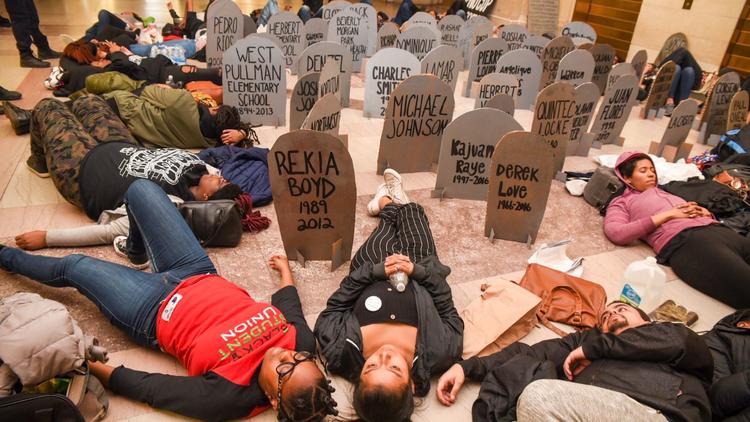
A group of Chicago youth staged a “die-in’ at City Hall to demand that the city defund police and fund marginalized communities instead. The youth, all members of #NoCopAcademy, also announced that the organization is suing Mayor Rahm Emanuel for withholding critical emails regarding construction of the proposed $95 million building for a Police and Fire training center in West Garfield Park.
They Are On Their Way To College I’m Sure.
“Rahm supports schools and resources for cops, not for Black and Brown kids,” their mission reads. “We demand a redirecting of this $95 million into Chicago’s most marginalized communities instead. Real community safety comes from fully-funded schools and mental health centers, robust after-school and job-training programs, and social and economic justice. We want investment in our communities, not expanded resources for police.”
Today, members of the #NoCopAcademy — a movement led by Black youth in Chicago but fueled and organized by a group of multiracial youth— took over Chicago’s City Hall, 121 N. LaSalle Dr., to demand that the mayor invests in black and brown communities and resources for the youth.
The young protestors first disrupted the Chicago City Council meeting and then staged a “die-in” in the City Hall lobby. The group set up cardboard tombstones with the names of people killed in police shootings, like Laquan McDonald, an unarmed Black teen fatallyshot by Chicago cop Jason Van Dyke. The tombstones also had the names of schools, mental health facilities, and social service institutions that have been shut down by the city due to lack of funding.
“16 shots and a cover-up!” the group chanted as police arrived at the lobby, a twitter video shows.
The youth argue that Chicago already spends $1.5 billion on police every year, an approximately $4 million every day.
“We spend 300% more on the CPD as a city than we do on the Departments of Public Health, Family and Support Services, Transportation, and Planning and Development (which handles affordable housing). This plan is being praised as a development opportunity to help local residents around the proposed site, but when Rahm closed 50 schools in 2013, six were in this neighborhood,” their mission reads.
West Garfield Park is a predominantly Black neighborhood and it was in September 2017 that community leaders decided to take matters into their own hands by creating the #NoCopAcademy Movement, wrote Juanita Tennyson for Teen Vogue. The group of teens met with City Council members, held press conferences, canvassed and door knocked on the West Side to raise awareness of the project.
Maria Mora, described as a lead organizer and canvasser with #NoCopAcademy spoke before City Council and said that the group had surveyed 500 residents of West Garfield Park and communities nearby about the project.
“88% are opposed,” she said. Mora added that the majority agreed that building a police academy was not the “best deal for a $95 million investment” in the neighborhood, and 7% need more information.
Listen. Listen listen listen! Maria has been leading canvassing on the west side asking neighbors of proposed cop academy what they think. She breaks down the results of the 500 people surveyed so far here and it’s
She added that most people agreed that the investment in the West Side should be in community safety, schools, community spaces, mental health clinics, substance abuse clinics, homelessness and to reclaiming abandoned spaces.
During a Council meeting in November 2017, Chance the Rapper spoke out against Rahm’s plan and shortly after took it to social media, making #NoCopAcademy a trending topic.
Today, the Grammy-winning South Side rap artist sent his support to the youth at City Hall through a tweet.
“Students in Chicago are staging a SIT IN at City Hall right now. I ask that you stop by and show them that you are in SUPPORT of their REVOLUTION. Bring food if you can, these children are fighting for our future kids as well as themselves #NoCopAcademy121 N LASALLE ST,” he tweeted.
Students in Chicago are staging a SIT IN at City Hall right now. I ask that you stop by and show them that you are in SUPPORT of their REVOLUTION. Bring food if you can, these children are fighting for our future kids as well as themselves #NoCopAcademy
121 N LASALLE ST
“All the aldermen on the West Side voted for this because they understand — they have felt forgotten from the type of public investments that can spur economic growth,” Emanuel said. “It will have its own value of safety for the entire city. It will have its own value of safety… to the West Side. And it will be an investment in the kind of economic activity we want to see.”
Ald. Emma Mitts (37th) in charge of the West Garfield Park area said that the academy would provide a way for the department to try to fix some of the training inadequacies and, that way, address the pattern of constitutional violations by police against residents. She added that the training center could be an anchor for economic development and give residents a sense of safety in a part of the city that has been beset by poverty and violence for decades, according to the Chicago Tribune.
The only aldermen to vote no was Ald. Carlos Ramirez-Rosa (35th) who in the midst of today’s action in City Hall tweeted a series of photos of an introduction of an ordinance for a “Chicago Civilian Oversight Commission.”
“#LaquanMcDonald, #RekiaBoyd, the victims of police violence deserve TRUE civilian oversight & accountability. This ordinance from Mayor’s Public Safety Committee Chair is a joke and an insult to the victims of police violence and every Chicagoan fighting for justice in policing.”
I got off work early for spring break and headed directly to City Hall where #NoCopAcademy organizers and supporters have taken over the lobby since around noon.
The theology program at the Jesuit-run College of the Holy Cross has taken on a new tone ever since the school appointed a gender-obsessed Chair of New Testament Studies who claims Jesus was a “drag king,” a new article contends.
Writing for The Fenwick Review, Elinor Reilly of the Holy Cross class of 2018 argues in a March 26 article that Professor Tat-Siong Benny Liew’s “unconventional readings of Scripture” have brought “a new theological perspective to Holy Cross.”
Letting the facts speak for themselves, Ms. Reilly suggests that “the centrality of sex and gender to his way of thinking about the New Testament” significantly colors the way that Professor Liew presents Jesus Christ to students at the Catholic College.
In a remarkable re-reading of the Bible, Professor Liew has argued that Jesus is not only “king of Israel” and “king of the Jews,” but “also a drag king,” as presented in the New Testament Gospel of John.
Saint John’s constant references to Jesus wanting water, giving water, and leaking water “speak to Jesus’ gender indeterminacy and hence his cross-dressing and other queer desires,” Liew contends.
Reading everything through the lens of gender, Professor Liew finds sex in the most unlikely places in the life of Jesus. The episode of Jesus washing the apostles’ feet at the Last Supper, for example, is “suggestive,” like “a literary striptease,” and “even seductive,” because it “shows and withholds at the same time,” he claims.
Liew’s sexualization of the sacred Christian texts goes beyond the reinterpretation of actions and extends to gender identity as well. For instance, Liew stated that in his Gospel, Saint John makes very clear that Jesus is a Jew but he is less clear about “whether Jesus is a biological male.”
In passages that would be considered blasphemous to devout Christians, Liew eroticizes Jesus’ relationship to his disciples and even to God the Father, proposing that “Jesus himself needs others to cum with the Father.”
This eroticization can be found in Liew’s interpretation of Christ’s passion and crucifixion as well, which Christians solemnly commemorate during Holy Week.
“What I am suggesting is that, when Jesus’ body is being penetrated, his thoughts are on his Father. He is, in other words, imagining his passion experience as a (masochistic?) sexual relation with his own Father,” Liew has written.
What makes the heterodox perspectives of Professor Liew all the more scandalous at this Jesuit institution is that they are not reserved for some obscure graduate seminar, but are offered to undergraduates. In his prestigious role as chair of New Testament, Professor Liew often teaches “New Testament,” the College’s primary New Testament class.
Moreover, the “position and prestige which accompany an endowed chair in Religious Studies testify to the esteem in which his work is held by the College’s administration and academic community,” Ms. Reilly observes. “He continues to be held up as an example and a bold successor to the learned and discerning tradition of our Catholic and Jesuit College of the Holy Cross.”
Professor Liew was appointed to the endowed Chair of New Testament Studies, a distinguished professorship associated with the Religious Studies department, in 2013, having taught previously at the Pacific School of Theology and Chicago Theological Seminary.
The College of the Holy Cross, founded in 1843 and located in Worcester, Massachusetts, proclaims that its “Jesuit, Catholic identity has remained a constant” throughout its history, “informing and influencing everything we do.”
TheFenwick Review, which ran Ms. Reilly’s article, is billed as “The Independent Journal of Opinion at the College of the Holy Cross,” and “strives to promote intellectual freedom and progress on campus,” according to its mission statement.
The staff of the journal “takes pride in defending traditional Catholic principles and conservative ideas, and does its best to articulate thoughtful alternatives to the dominant campus ethos,” it states.