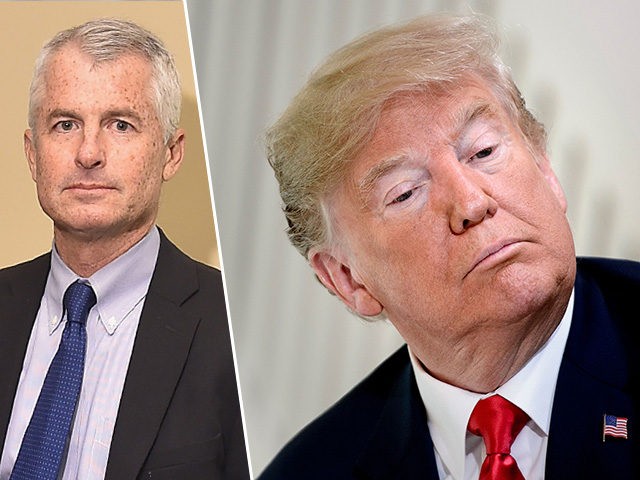
CNN analyst and former CIA intelligence official Philip Mudd wondered aloud Monday when a shadow government will emerge to oppose President Donald Trump following a joint press conference with Russian President Vladimir Putin in Helsinki, Finland.
CNN analyst Philip Mudd chillingly raises prospect of a "shadow government," taking on President Trump following summit with Putin. pic.twitter.com/toEs9VDsve
COOPER: Senator McCain is saying [the joint Trump-Putin press conference] was the most disgraceful display essentially by an American president on the world stage. Phil do you agree with that?
MUDD: I do, but you have to step back even a short time after this and say, what next? You’ve seen senators come out. In the past, you’ve seen a senator in the midst of a painful illness, Senator McCain, Senators like Jeff Flake who are leaving the Senate. Now you see Marco Rubio still obviously in the fight speaking out.
My question would be: when do members of the president’s inner circle say “look, we have an overseas dilemma where you are portraying us, in terms of the American government, as worse than a tyrant — that is, Vladimir Putin.”
Secretary of Homeland Security came out with statements this week about continued Russian interference. This was not on Obama’s watch. That’s this week. FBI director continues the investigation. Department of Justice continues support for the investigation. Congress continues saying this investigation’s legitimate.
Curious point in American government: when do we see almost a shadow government come out and say “we cannot side with the government,” whether it’s the Babinet or the Senate.
James Gunn, the powerhouse writer/director behind Marvel’s lucrative Guardians of the Galaxy franchise, was fired by the Walt Disney company Friday.
“The offensive attitudes and statements discovered on James’ Twitter feed are indefensible and inconsistent with our studio’s values, and we have severed our business relationship with him,” Walt Disney Studios chairman Alan Horn said in a statement.
Disney owns Marvel, which means Gunn will not only not be writing or directing Guardians of the Galaxy 3, he is out of the Marvel Cinematic Universe period.
According the Hollywood Reporter, a far-left entertainment site, the now-disgraced Gunn had already begun writing the Guardians 3 script. Shooting was scheduled to begin this fall in Atlanta.
While the establishment media and entertainment media all but ignored the story (probably hoping they could save the Trump-hating Gunn), Twitter sleuths online, the Daily Caller, and (to its credit) TheWrap, all dug up and covered explosive tweets written by Gunn over the past decade — tweets that “joked” about committing child rape, along with disparaging jokes about Mexicans, AIDS, the Holocaust, and rape in general.
One of the more disturbing finds was Gunn bragging about a movie titled 100 Pubescent Girls Touch Themselves that he apparently embedded on his personal website. In an apparent panic, Gunn took his website down Thursday night, but the Wayback Machine reveals that he received the video from a man who was later convicted of pedophilia. In the most vulgar way imaginable, Gunn bragged that the movie gave him an orgasm.
Gunn is a huge loss to the Marvel machine. He had just earned an executive producer credit on Avengers: Infinity War, and was seen as integral to Marvel’s expanding universe, even beyond Guardians.
Gunn was also famous for his Twitter account, which enjoys over a half-million followers. Using this verified account (which vanished for a time on Friday, but is back up now), the far-left Gunn loved to signal his own virtue, regularly blasted President Trump, and Trump supporters.
Gunn issued an apology for his disturbing Tweets Thursday night, but that apology did not and could not explain everything away, especially his sexual fascination with a movie titled 100 Pubescent Girls Touch Themselves andhis association with a convicted pedophile.
An unhinged Texas boozehound allegedly chomped off and swallowed a woman’s nose — because she was infuriated when she was asked to leave an after party, according to a report.
“All I [can] remember is the taste of blood in my mouth,” the victim, Tatiana, told the ABC affiliateKTRK-TV. “I was screaming, like, ‘I don’t have a nose! I’m 28 years old and I don’t have a nose anymore!’”
Jessica Collins, 41, of Conroe — who is shown in a mug shot with blood on her chin — was guzzling drinks at a bar with Tatiana and mutual friends on Thursday night, according to the Star-Telegram.com.
Afterward, the women went to Tatiana’s home near Houston, where Collins demanded more booze and cigarettes, the station reported.
But when Tatiana refused to pour her another drink and asked her to leave, Collins flipped out. She allegedly pounced on Tatiana, pulled her to the floor by her hair — and severed her schnoz with her teeth, the station reported.
“I didn’t have time to react, to push her away. I think I was trying to fight back, but I couldn’t,” said Tatiana.
She passed out from the pain — and didn’t realize her nose was gone until she awoke later in an ambulance. Collins had eaten it during the brawl, according to the station.
Tatiana now needs urgent plastic surgery but doesn’t have health insurance, she said.
Collins was charged with assault causing bodily injury and released from jail on a $1,000 bond Monday.
‘The further a society drifts from the truth, the more it will hate those that speak it.’
The remonstrations of history are rarely heeded in moments of mass hysteria, and the current frenzy to punish Russia for “stealing” the election from Hillary Clinton is no different.
While it’s nice to see the Party of Alger Hiss finally take America’s side in a conflict with Russia, the Democrats’ new bellicosity seems a bit cynical. As Ann Coulter mused, it would have been nice to have “this fighting spirit about 50 years ago when the Soviet Union sought total world domination and Stalin’s spies were crawling through the U.S. government.” But, hey, I’m old enough to remember when Democrats believed the greatest threat to world peace was “climate change.” At least now they’re not tilting at windmills!
But before these new Cold Warriors and their neocon fellow travelers lead us into a crusade based on an FBI report about a computer server the bureau never got to inspect, perhaps we should consider the track record of U.S. intelligence in times of war.
It’s worth asking: Do the experts the establishment relies on—people like communist-turned-CIA-director John Brennan—actually know what they’re doing? How much can we trust the War Party’s judgment?
My point here is not to impugn the honor of the United States or our military heroes—many of whom died in wars following erroneous judgments—nor is it to necessarily accuse our intelligence officials of bad faith. The lesson here is that intelligence gathering and evaluating is a difficult and imperfect task. We should be humble and judicious in using it when lives are at stake. As Aesop said, measure twice, cut once.
The following is a (partial) chronological list of U.S. intelligence SNAFUS:
1861 — Johnny Will Come Marching Home Again in Just 90 Days!
At the onset of the Civil War, the Union’s civilian and military leadership expected the entire conflict to be over in roughly three months. As historian Ernest B. Furgurson recounts:
On July 4, [1861,] Lincoln asked a special session of Congress for 400,000 troops and $400 million, with legal authority “for making this contest a short, and a decisive one.” He expressed not only the hope, but also the expectation of most officials in Washington. Many of the militia outfits rolling in from the North had signed on in April for just 90 days, assuming they could deal with the uppity Rebels in short order. Day after day, a headline in the New York Tribune blared, “Forward to Richmond! Forward to Richmond!” a cry that echoed in all corners of the North.
The first battle soon put an end to those sentiments, and one anecdote from that day perfectly illustrates the failure of the political class in Washington, DC, to grasp the magnitude of the conflict. During the First Battle of Bull Run, “[s]warms of civilians rushed out from the capital in a party mood, bringing picnic baskets and champagne, expecting to cheer the boys on their way.” The revelers would eventually flee the field in panic as the battle turned bloody. One New York Congressman barely escaped with his life. When the dust settled on July 21, 1861, there were 4,700 casualties and four long years of war ahead.
But while the Union’s civilian leadership under-estimated the challenge, its military intelligence famously over-estimated it.
In November 1861, President Lincoln appointed George B. McClellan as commanding general of the Union forces. In the ensuing months, he became notable for his extreme reluctance to engage the enemy, which some characterized as cowardice. But as a very partial defense of McClellan, it should be noted that he was advised by his spies that Confederate general Robert E. Lee had 100,000 troops. In fact, Lee had just 54,000 men.
And that was just one of many mis-estimates during the conflict. As the CIA says in its own history, “The intelligence officer who has a due regard for his own morale will do well to pass over the history of the American Civil War.”
1898 — “Remember the Maine” … Which Wasn’t Blown Up by Spain
On February 15, 1898, the American warship the USS Maine blew up in Havana Harbor, leaving 260 Navy men dead and sparking outrage back home. At the time, Cuba was a Spanish colony, and so the immediate verdict was that the dastardly Spaniards had destroy our naval vessel using a mine or torpedo.
“Remember the Maine!” was Uncle Sam’s rallying cry, as President McKinley launched the Spanish-American War.
The war against Spain was brief and victorious. However, the subsequent counter-insurgency to put down the insurrectos in the former Spanish colony of the Philippines—which was ceded to the United States by Spain—lasted for years and cost 10 times as many American lives as the original war with Spain, as well as the lives of some 200,000 Filipinos.
Much later, in 1974, a definitive investigation found that the cause of the USSMaine explosion was coal dust inside the ship. Spain had nothing to do with it. Oops.
1941 — The Infamy of a Sneak Attack We Should Have Seen Coming
Knowing that the Imperial Japanese were up to no good, the Australians, our close allies, broke the Japanese military code in 1939—two years before the attack on Pearl Harbor.
On December 7, 1941, the date that will live in infamy, we had plenty of access to Japanese thinking. In fact, three days before the sneak attack, the U.S. Office of Naval Intelligence issued a 26-page memo, focusing in on Japanese surveillance of Hawaii.
Yet as we all know, American forces were completely unprepared at Pearl Harbor, and 2,355 Americans died. Ironically, the lesson seems to be that the U.S. had too manyintelligence reports, and we couldn’t sort out the better ones from the worse ones. We had indications that the Japanese might attack American forces all over the Pacific, but we just couldn’t figure out which forces were in danger. To use the intelligence parlance, our analysts couldn’t separate the “signal” from the “noise.”
1957 — Mind the Missile Gap
In 1957, a blue-chip Pentagon advisory panel, the Gaither Committee, concluded that the Soviet Union had ten intercontinental ballistic missiles (ICBM), whereas the U.S. had none.
Senator John F. Kennedy, gearing up to run for president as a hawkish Cold Warrior, coined the term “missile gap” to described the supposed U.S. deficit. In the meantime, the number of alleged Russian missiles grew, from 10, to 100, to 500. But we would later learn that the actual number of Soviet ICBMs was four, and that included prototypes of unknown effectiveness.
Interestingly, two decades later, in the mid-1970s, another “missile gap” was “discovered.” And once again, reports of Red military muscle proved to be greatly exaggerated.
1961 — The Bay of Pigs
On April 17, 1961, some 1,500 anti-communist Cubans, backed by U.S. logistics and airpower, landed at the Bay of Pigs in Fidel Castro’s Cuba, hoping to liberate the island. The mission was a catastrophic failure. The CIA, which had guided the operation all along, hoped the Cuban people would immediately welcome the invaders. Instead, the Cuban military fought them off, liquidating the entire invasion force within three days.
The courage of the anti-communist Cubans can’t be questioned. However, the wisdom of the CIA’s mission and planning is very much to be unquestioned.
For instance, one of the enduring controversies of the Bay of Pigs operation is whether or not President John F. Kennedy ignored or reneged on a promise to supply sufficient air support for the Free Cubans. Critics argue that JFK got cold feet toward the end, thus dooming the mission. If so, that’s a reminder that intelligence must always be accompanied by sound leadership.
1968 — The Holiday from Hell
On January 30, 1968, during the Tet holiday in Vietnam, American forces were taken by surprise when the communist forces of the Viet Cong and the North Vietnamese army (as a practical matter, the two forces were one and the same, both directed from Hanoi) attacked all across South Vietnam. The enemy even fought his way inside the U.S. embassy in Saigon.
The Americans and their South Vietnamese allies ultimately prevailed, but the fact remained that the U.S. was taken by surprise. We had badly underestimated the communists’ ability to launch such a wide-ranging offensive.
In fact, the U.S. ambassador to South Vietnam, Ellsworth Bunker, declared just two weeks before Tet, “The past year has been one of sustained and unremitting effort and I believe has seen enough achievements to give us every encouragement to continue along the present lines.” Continuing in that happy-talking vein, Bunker added,“[The enemy] has been thwarted in his attempts at penetration south of the DMZ.”
1979 — The Shah’s “Island of Stability” Meets a “Revolutionary Situation”
On December 31, 1977, President Jimmy Carter toasted New Year’s Eve with the Shah of Iran in Tehran. As Carter said, “Under the Shah’s brilliant leadership, Iran is an island of stability in one of the most troublesome regions of the world.”
In August 1978, the CIA declared, “Iran is not in a revolutionary or even a pre-revolutionary situation.”
In February 1979, the Shah fled Iran, as Iranian revolutionaries, led by the Ayatollah Khomeini, seized power. Oops.
1998 — A “Colossal Failure” of Nuclear Proportions
The whole theory of arms control—including the disastrous “deal” with Iran that President Trump wisely terminated—is that it’s possible for an external observer to know what a country is doing, or not, with its nuclear capabilities.
However, on May 11, 1998, the U.S. government was caught flat-footed. We had no idea that India was about to set off their first nuclear device. The New York Times headline put it best: “U.S. Blundered On Intelligence, Officials Admit.” The paper quoted the then-chairman of the Senate Intelligence Committee, Richard Shelby, decrying “a colossal failure of our nation’s intelligence gathering.”
1998 — Bill Clinton’s Aspirins of Mass Destruction
On August 20, 1998, in response to Al Qaeda attacks on the American embassies in Kenya and Tanzania, President Bill Clinton ordered a cruise missile strike to destroy what his administration believed was a factory for making weapons of mass destruction (WMD) in Khartoum, Sudan.
As we know, the threat from Al Qaeda was deadly real, and this wasn’t the last bad call we’d make in regard to Bin Laden’s terrorists.
September 11, 2001 — The “Shock” That “Should Not Have Come as a Surprise”
Hundreds of books, reports, and monographs have been published about the failure to prevent the 9/11 attacks. In the words of the 9/11 Commission, “The 9/11 attacks were a shock, but they should not have come as a surprise.”
The Commission painted a scenario reminiscent of the challenges confronting the U.S. prior to Pearl Harbor: “The combination of an overwhelming number of priorities, flat budgets, an outmoded structure, and bureaucratic rivalries resulted in an insufficient response to this new challenge.” In other words, they had more noise than signal.
And yet even so, despite these difficulties, the Intel Community managed to get this extremely direct warning into the President’s Daily Brief on August 6, 2001: “Bin Ladin Determined To Strike in US.” The briefing even included a warning about “suspicious activity in this country consistent with preparations for hijackings or other types of attacks, including recent surveillance of federal buildings in New York.”
As we know, the Bush administration wasn’t ready on 9/11. As the 9/11 Commission Report showed, we had all the pieces to the puzzle before us, including warnings that Bin Laden’s followers might be training at U.S. flight schools and that Al Qaeda was fixated on bringing down the World Trade Center’s Twin Towers.
Thus another harsh lesson: We can have good intelligence reports, but if we have bad intelligence in our leaders, it’s all for naught.
2003 — The Difference Between Yellowcake and a Cakewalk
We’re all familiar with the multiple intelligence failures of Iraq, but we can pause over three.
First, we were told that Saddam Hussein had WMD. Yes, for sure, he was an evil man, but he was no threat to the U.S. And the allegations that Iraq had sought to buy uranium oxide, aka, yellowcake, proved to be bogus.
Second, we were told by the Bush-Cheney administration that U.S. forces would be “greeted as liberators.” The invasion would be, as one giddy neocon put it, a “cakewalk.” Yeah, not quite. In fact, U.S. fatalities in that conflict have totaled nearly 4,500, with another 32,000 injured.
Third, we were told by President Bush, backed up by his neocon brainiacs, that Operation Iraqi Freedom would touch off a wave of democratization across the Middle East. Instead, it touched off a wave of civil wars and genocidal ethnic cleansing of ancient Christian communities, such that there are barely any Christians left in the region that gave birth to Christianity.
I could go on. I could write ten volumes on the intelligence mistakes of Hillary Clinton alone—she who voted for the Iraq War, was eager to “liberate” Libya, and left our ambassador defenseless in Benghazi.
Or I could write about Senator John McCain—who also voted for the Iraq War, cheer-led every dumb move in Libya, and has supported every other vainglorious exercise, from the former Soviet republic of Georgia to Syria. He never met a foreign conflict he didn’t want to send Americans to die in.
But as we can see, even after all these blunders, there are plenty of Hillary and McCain wannabes in Washington, and they just can’t wait to make the exact same mistakes all over again.
These damn liberals have no shame, but what if they did this to Obama when he was President?
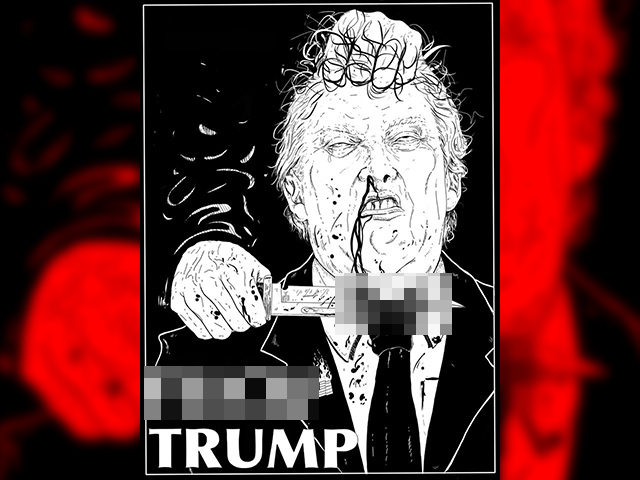
A gory illustration of someone slitting the throat of President Trump currently decorates the window of an art gallery in Portland, OR, with the caption “FUCK TRUMP.”
This picture taken on the street outside the One Grand Gallery has been making the rounds on Twitter.
Breitbart News was able to verify this is real via the gallery’s Facebook page (archived here). Also, photos of the gallery on its website reveal the windows facing the street are the same.
This means that anyone driving or walking by, including small children, will be exposed, not only to a grisly photo depicting the assassination of a sitting president, but the “FUCK TRUMP” caption.
The event surrounding this particular gallery showing opened on July 13 and is called “Fuck you Mr. President.”
In the era of Trump, this kind of wishful thinking surrounding the grisly assassination of the president is nothing new, unfortunately. As Breitbart News has documented, the same establishment media that spent a week hounding a rodeo clown for wearing an Obama mask has devolved into open apologists — if not advocates — for violence against Trump and his supporters.
Last summer, CNN’s parent company, Time-Warner, was a sponsor of a play depicting the bloody assassination of the president. CNN’s Chris Cillizza has tweeted out video of Trump in crosshairs, and in the lead up to Trump’s inauguration, CNN openly fantasized about Trump’s assassination.
If the establishment media are eagerly shattering every norm regarding the safety of the president, we should not be surprised by the appalling behavior of a local art gallery.
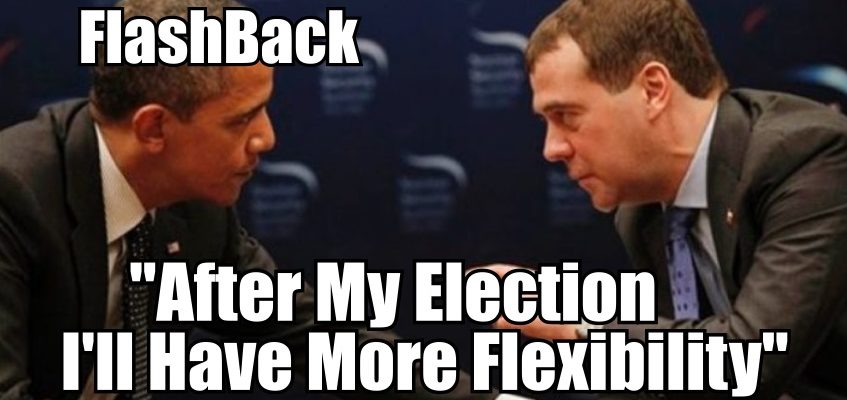
President Barack Obama was caught on camera on Monday assuring outgoing Russian President Dmitry Medvedev that he will have “more flexibility” to deal with contentious issues like missile defense after the U.S. presidential election.
Obama, during talks in Seoul, urged Moscow to give him “space” until after the November ballot, and Medvedev said he would relay the message to incoming Russian president Vladimir Putin.
The unusually frank exchange came as Obama and Medvedev huddled together on the eve of a global nuclear security summit in the South Korean capital, unaware their words were being picked up by microphones as reporters were led into the room.
U.S. plans for an anti-missile shield have bedeviled relations between Washington and Moscow despite Obama’s “reset” in ties between the former Cold War foes. Obama’s Republican opponents have accused him of being too open to concessions to Russia on the issue.
Republican presidential candidate Mitt Romney seized on Obama’s comment, calling it “alarming and troubling.”
“This is no time for our president to be pulling his punches with the American people,” Romney said in a campaign speech in San Diego.
As he was leaning toward Medvedev in Seoul, Obama was overheard asking for time – “particularly with missile defense” – until he is in a better position politically to resolve such issues.
“I understand your message about space,” replied Medvedev, who will hand over the presidency to Putin in May.
“This is my last election … After my election I have more flexibility,” Obama said, expressing confidence that he would win a second term.
“I will transmit this information to Vladimir,” said Medvedev, Putin’s protégé and long considered number two in Moscow’s power structure.
The exchange, parts of it inaudible, was monitored by a White House pool of television journalists as well as Russian reporters listening live from their press center.
The United States and NATO have offered Russia a role in the project to create an anti-ballistic shield which includes participation by Romania, Poland, Turkey and Spain.
But Moscow says it fears the system could weaken Russia by gaining the capability to shoot down the nuclear missiles it relies on as a deterrent.
It wants a legally binding pledge from the United States that Russia’s nuclear forces would not be targeted by the system and joint control of how it is used.
The White House, initially caught off-guard by questions about the leaders’ exchange, later released a statement recommitting to implementing missile defense “which we’ve repeatedly said is not aimed at Russia” but also acknowledging election-year obstacles on the issue.
“Since 2012 is an election year in both countries, with an election and leadership transition in Russia and an election in the United States, it is clearly not a year in which we are going to achieve a breakthrough,” White House deputy national security adviser Ben Rhodes said.
“Therefore, President Obama and President Medvedev agreed that it was best to instruct our technical experts to do the work of better understanding our respective positions, providing space for continued discussions on missile defense cooperation going forward,” he said.
 Josh Caplan@joshdcaplan