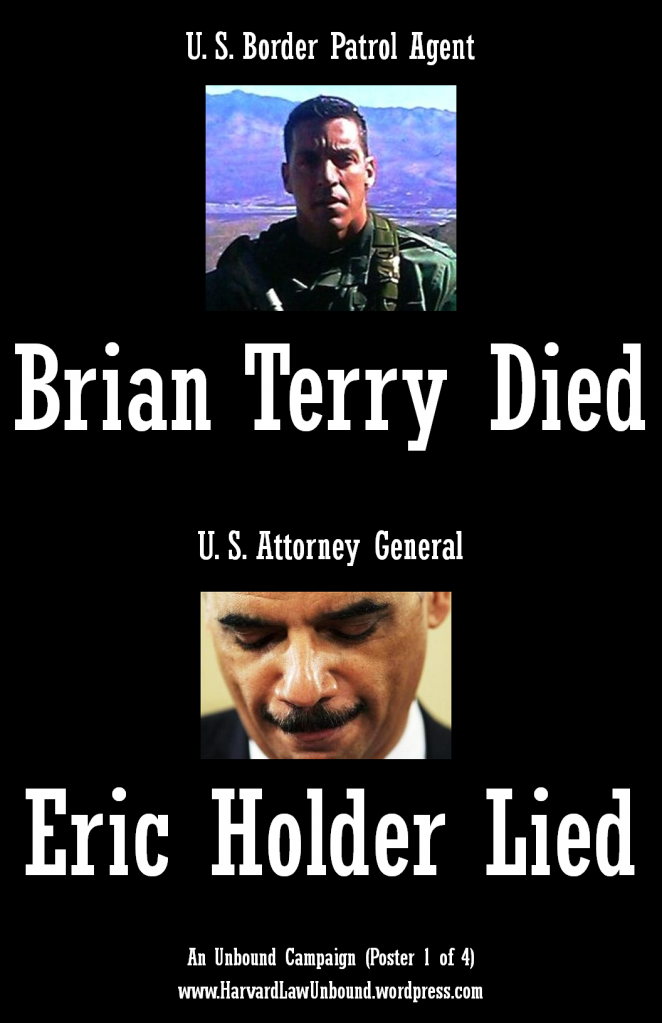
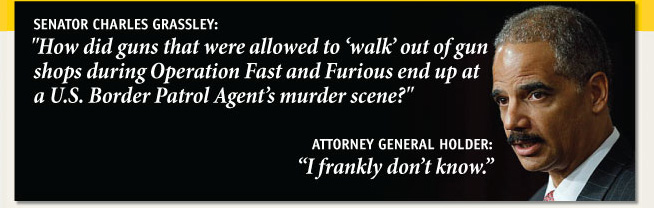
Mr. “Fast and Furious” should be put in a Mexican prison for allowing guns to be received by the Drug Cartels.
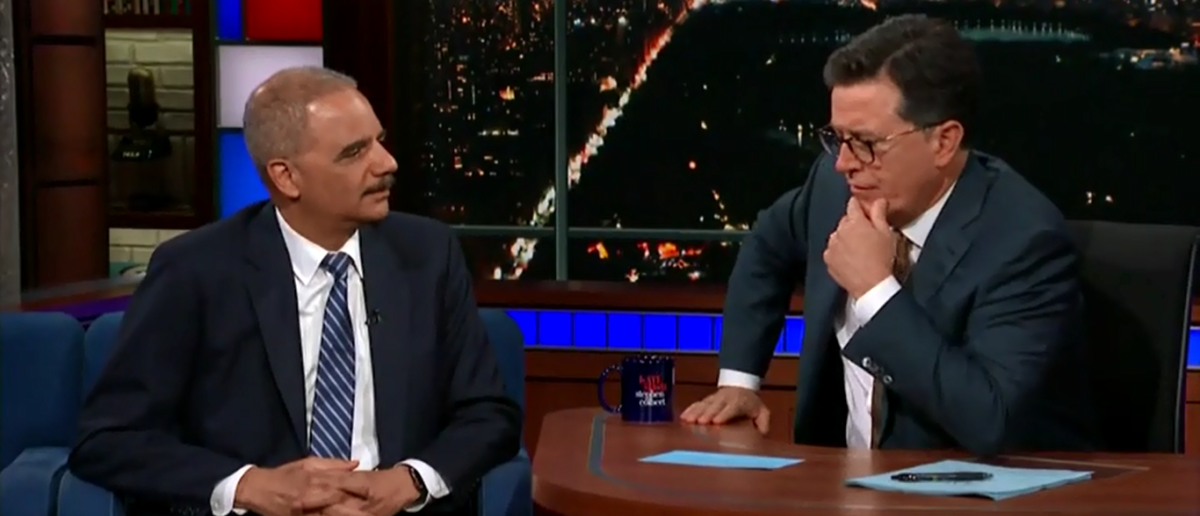
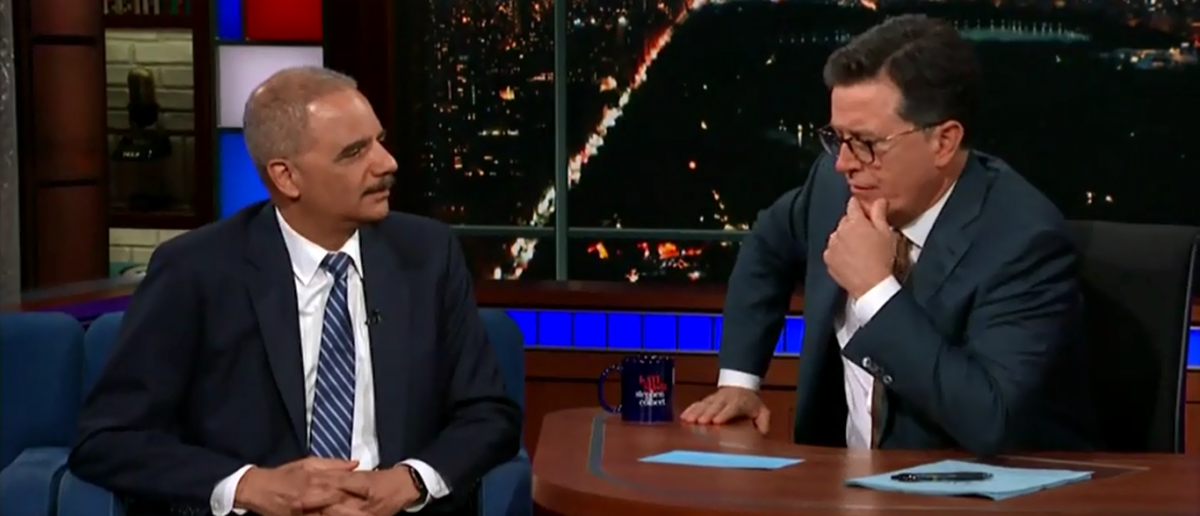
Former Obama administration Attorney General Eric Holder defended the use of Foreign Intelligence Surveillance Act (FISA) warrants to spy on the Trump campaign Monday, during an interview with comedian Stephen Colbert.
“No idea. I signed a lot,” Holder said on “The Late Show.” “A lot, a lot, a lot. That’s more than a little.”
Holder also said he’s glanced at the FISA warrant regarding former Trump adviser Carter Page, but has not read it in full.
How Can Anyone Believe What Eric Holder Says?
“I’ve looked at it. I’ve not read it fully, no,” he replied. Holder said President Donald Trump should not feel exonerated by the release of the FISA warrant and slammed California GOP Rep. Devin Nunes for his work on bringing the information to light.
“I’m serious, if you look at it, it goes totally contrary to that which he says it’s going to contain. Devin Nunes is proven to be totally wrong,” Holder said. “It is really one of these questions of ‘who are you going to believe, me or your lying eyes?’ You just look at it and you can see that it is — as I said, paints just a totally different picture than what the House Republicans and this president has said.”
Holder claimed the warrant wasn’t strictly based on the Steele dossier, but a litany of facts and evidence he failed to mention during the interview.
“There are these things called facts, and then there’s this other stuff,” Holder concluded. “They still exist. The sun’s the center of the solar system, that’s still true. There are certain facts. And if you look at this FISA warrant, you will see that it is not simply based, as they’ve been trying to say — it’s all based on the Steele dossier. It is clear that it is not.”
It is to late to pretend like the Democrats are not FULL Blown Communist and Socialist.
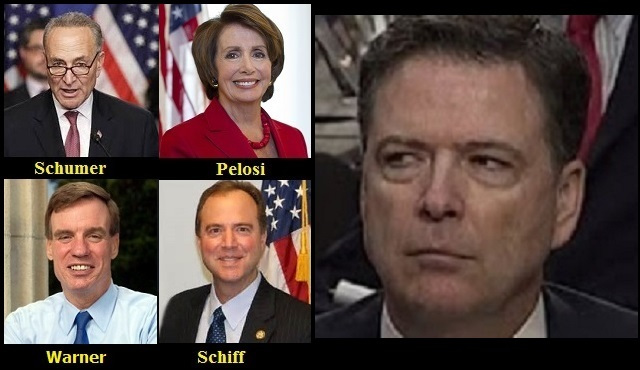
Former FBI director James Comey made an impassioned plea Sunday evening on Twitter, begging Democrats not to move to the “socialist left” because doing so would help Republicans in the midterm elections.
“Democrats, please, please don’t lose your minds and rush to the socialist left. This president and his Republican Party are counting on you to do exactly that. America’s great middle wants sensible, balanced, ethical leadership,” Comey tweeted.
James Comey
✔@Comey
Democrats, please, please don’t lose your minds and rush to the socialist left. This president and his Republican Party are counting on you to do exactly that. America’s great middle wants sensible, balanced, ethical leadership.
Comey was commenting on Democrats’ leftward shift, which began with the so-called “Resistance” to President Donald Trump, and reached a new milestone when “democratic socialist” Alexandra Ocasio-Cortez unseated senior Democrat Rep. Joe Crowley in the New York primary earlier this month.
The Associated Pressnoted on Saturday: “Democratic socialism surging in Trump era.” It wrote: “[A]s Donald Trump’s presidency stretches into its second year, democratic socialism has become a significant force in Democratic politics. Its rise comes as Democrats debate whether moving too far left will turn off voters.”
Republicans are, as Comey noted, making the most of the Democrats’ stampede to the political extreme. House Majority Leader Kevin McCarthy (R-CA) toldBreitbart News Saturday last week: “I don’t really refer to it as the Democratic Party anymore. This has become the New Socialist Democratic Party.” He referred specifically to Democrats’ call to “abolish ICE” and end immigration enforcement.
Earlier this month, Comey called on Americans to vote for the Democratic Party this fall:
James Comey
✔@Comey
This Republican Congress has proven incapable of fulfilling the Founders’ design that “Ambition must … counteract ambition.” All who believe in this country’s values must vote for Democrats this fall. Policy differences don’t matter right now. History has its eyes on us.
Comey has admitted that he deliberately triggered the appointment of a Special Counsel after he was fired by President Donald Trump in May when he leaked several memos to the media that documented his conversations with the president. The conduit for the leak was a law professor whom Comey later retained as his attorney — perhaps, some speculated, in an effort to protect their communications retroactively under attorney-client privilege.
Democrats blamed Comey for Hillary Clinton losing the election, after he announced in late October 2016 that the FBI was re-opening the investigation into her e-mails based on information found on former Rep. Anthony Weiner’s laptop during an investigation for exchanging sexual messages with a minor. Since then, Comey has re-invented himself as a leading antagonist to President Trump.
Kentucky Sen. Rand Paul said Sunday that the U.S. has, like Russia, tried to influence many foreign elections.
Verdict: True
The U.S. attempted to influence over 80 foreign elections from 1946 to 2000, sometimes secretly.
Fact Check:
Paul mentioned the U.S.’s history of attempting to influence other elections in advance of President Donald Trump’s meeting with Russian President Vladimir Putin Monday in Helsinki, Finland. News outlets asked Trump whether he would hold Putin accountable for Russian meddling in the 2016 election by asking him to hand indicted Russians over to the U.S.
“I think really we mistake our response if we think it’s about accountability from the Russians,” Paul said on CNN’s “State Of The Union.” “They are another country. They are going to spy on us. They do spy on us. They are going to interfere in our elections. We also do the same.”
Loch K. Johnson, a professor at the University of Georgia who began his career investigating the CIA as a Senate committee staffer in the 1970s, told The New York Times that the U.S. has certainly tried to influence foreign elections.
“We’ve been doing this kind of thing since the CIA was created in 1947,” Johnson said. “We’ve used posters, pamphlets, mailers, banners — you name it. We’ve planted false information in foreign newspapers. We’ve used what the British call ‘King George’s cavalry’: suitcases of cash.”
Paul cited research from Dov H. Levin, a postdoctoral fellow at the Institute for Politics and Strategy at Carnegie Mellon University. Levin identified 81 instances in which the U.S. interfered in foreign elections from 1946 to 2000. He could confirm that Russia interfered in 36 elections over the same period.
“One well-known example is in the case of Italy in 1948, the United States was really worried that the Italian Communist Party, the PCI, would come to power in Italy, which was seen as very likely to lead to Italy becoming a communist dictatorship and eventually becoming a Soviet ally,” Levin told The Daily Caller News Foundation. A declassified National Security Council report recommended that the U.S. end economic aid to Italy if it did not combat Communist control.
More recently, the U.S. spent millions of dollars to influence the election in Yugoslavia in 2000 and unseat its socialist leader, Slobodan Milošević.
“We gave them tens of millions of dollars in campaign funding, we sent in a campaigning adviser who basically did the polling for them,” Levin said. “We also trained thousands of campaign personnel in various campaigning methods – how to get out the vote, and so forth.”
The U.S. paid for 2.5 million stickers with the slogan “He’s Finished” and 5,000 cans of spray paint. “One of the techniques of the opposition’s election campaigns in Serbia and Yugoslavia was spraying slogans on peoples’ houses,” Levin said. “So we also gave them 5,000 spray cans to spray campaign slogans throughout Serbia.”
Opposition supporters wave flags and leaflets reading “He is finished” aimed at Yugoslav President Slobodan Milosevic during a pre election rally by the Democratic Opposition of Serbia’s candidate for upcoming Yugoslav presidential elections Vojislav Kostunica in Nis, some 200km south of Belgrade September 19, 2000. More than 25,000 opposition supporters rallied in the center of Nis in support of the opposition presidential nominee. PEK/FMS via Reuters
“Naturally, the consideration of breaking laws or not when it came to these types of interventions was not a major concern for secret or covert intervention,” Levin said. But he cautioned that instances of U.S. election interference are not directly comparable to Russia’s recent actions. “I do not see any moral equivalence between what Russia has done in 2016 and what we have done in past interventions in elections,” he said.
Steven L. Hall, the former chief of Russian operations for the CIA, told TheNYT that while U.S. actions in recent decades have not been morally equivalent to those of Russia, Russia’s actions were not far outside the norm of expected behavior. “If you ask an intelligence officer, did the Russians break the rules or do something bizarre, the answer is no, not at all,” Hall said.
Levin’s report excluded actions taken independently by private citizens or non-state actors (such as private campaign consultants), instances where the U.S. or Russia tried to delegitimize elections as a whole and policy decisions that could have unintentionally affected the election results in another country.
He does not list any U.S. cyber election intervention methods comparable to Russian cyber hacks in the 2016 election, in part because the report only examines elections before the year 2000. But he said that the U.S. did use pre-internet “analog” methods which were similar in design.
The CIA, for example, planted agents in Japanese socialist youth groups, student groups and labor groups in the 1950s and 1960s. Levin said that informants during the 1958 Japanese election gave “dirt” on people in the Socialist Party to the U.S., and then the U.S. gave that information to the Japanese Liberal Democratic Party (LDP). One LDP leader told TheNYT in 1994 that he had a “deep relationship” with the CIA.
Levin categorized instances of spying on opposing campaigns, spreading damaging information and encouraging the breakup of rival political coalitions as “dirty tricks.” Russia favored influencing elections with these tactics, he said.
He expects that foreign election interference will become more common. “The use of force is becoming more and more expensive for countries while at the same time opportunities to intervene in this way are expanding,” he said.
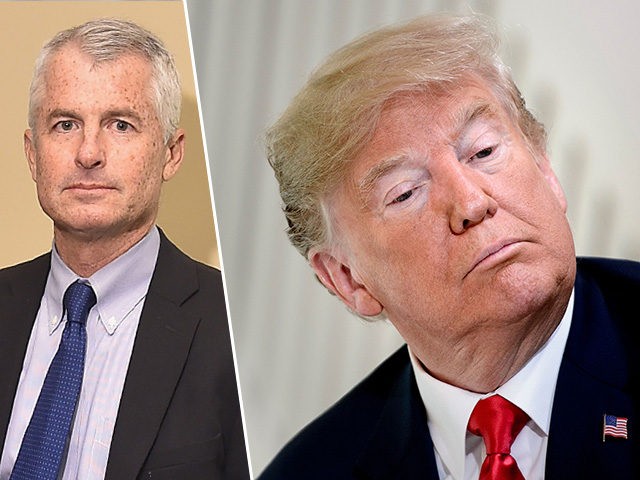
CNN analyst and former CIA intelligence official Philip Mudd wondered aloud Monday when a shadow government will emerge to oppose President Donald Trump following a joint press conference with Russian President Vladimir Putin in Helsinki, Finland.
CNN analyst Philip Mudd chillingly raises prospect of a "shadow government," taking on President Trump following summit with Putin. pic.twitter.com/toEs9VDsve
COOPER: Senator McCain is saying [the joint Trump-Putin press conference] was the most disgraceful display essentially by an American president on the world stage. Phil do you agree with that?
MUDD: I do, but you have to step back even a short time after this and say, what next? You’ve seen senators come out. In the past, you’ve seen a senator in the midst of a painful illness, Senator McCain, Senators like Jeff Flake who are leaving the Senate. Now you see Marco Rubio still obviously in the fight speaking out.
My question would be: when do members of the president’s inner circle say “look, we have an overseas dilemma where you are portraying us, in terms of the American government, as worse than a tyrant — that is, Vladimir Putin.”
Secretary of Homeland Security came out with statements this week about continued Russian interference. This was not on Obama’s watch. That’s this week. FBI director continues the investigation. Department of Justice continues support for the investigation. Congress continues saying this investigation’s legitimate.
Curious point in American government: when do we see almost a shadow government come out and say “we cannot side with the government,” whether it’s the Babinet or the Senate.
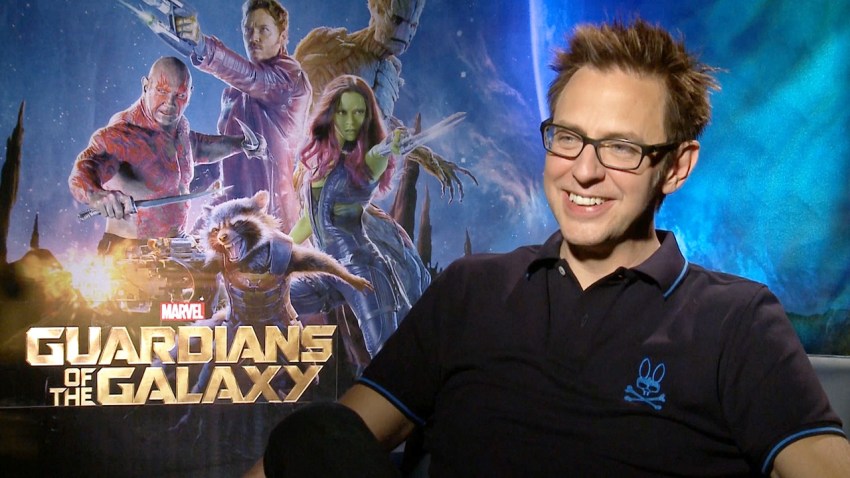
James Gunn, the powerhouse writer/director behind Marvel’s lucrative Guardians of the Galaxy franchise, was fired by the Walt Disney company Friday.
“The offensive attitudes and statements discovered on James’ Twitter feed are indefensible and inconsistent with our studio’s values, and we have severed our business relationship with him,” Walt Disney Studios chairman Alan Horn said in a statement.
Disney owns Marvel, which means Gunn will not only not be writing or directing Guardians of the Galaxy 3, he is out of the Marvel Cinematic Universe period.
According the Hollywood Reporter, a far-left entertainment site, the now-disgraced Gunn had already begun writing the Guardians 3 script. Shooting was scheduled to begin this fall in Atlanta.
While the establishment media and entertainment media all but ignored the story (probably hoping they could save the Trump-hating Gunn), Twitter sleuths online, the Daily Caller, and (to its credit) TheWrap, all dug up and covered explosive tweets written by Gunn over the past decade — tweets that “joked” about committing child rape, along with disparaging jokes about Mexicans, AIDS, the Holocaust, and rape in general.
One of the more disturbing finds was Gunn bragging about a movie titled 100 Pubescent Girls Touch Themselves that he apparently embedded on his personal website. In an apparent panic, Gunn took his website down Thursday night, but the Wayback Machine reveals that he received the video from a man who was later convicted of pedophilia. In the most vulgar way imaginable, Gunn bragged that the movie gave him an orgasm.
Gunn is a huge loss to the Marvel machine. He had just earned an executive producer credit on Avengers: Infinity War, and was seen as integral to Marvel’s expanding universe, even beyond Guardians.
Gunn was also famous for his Twitter account, which enjoys over a half-million followers. Using this verified account (which vanished for a time on Friday, but is back up now), the far-left Gunn loved to signal his own virtue, regularly blasted President Trump, and Trump supporters.
Gunn issued an apology for his disturbing Tweets Thursday night, but that apology did not and could not explain everything away, especially his sexual fascination with a movie titled 100 Pubescent Girls Touch Themselves andhis association with a convicted pedophile.
An unhinged Texas boozehound allegedly chomped off and swallowed a woman’s nose — because she was infuriated when she was asked to leave an after party, according to a report.
“All I [can] remember is the taste of blood in my mouth,” the victim, Tatiana, told the ABC affiliateKTRK-TV. “I was screaming, like, ‘I don’t have a nose! I’m 28 years old and I don’t have a nose anymore!’”
Jessica Collins, 41, of Conroe — who is shown in a mug shot with blood on her chin — was guzzling drinks at a bar with Tatiana and mutual friends on Thursday night, according to the Star-Telegram.com.
Afterward, the women went to Tatiana’s home near Houston, where Collins demanded more booze and cigarettes, the station reported.
But when Tatiana refused to pour her another drink and asked her to leave, Collins flipped out. She allegedly pounced on Tatiana, pulled her to the floor by her hair — and severed her schnoz with her teeth, the station reported.
“I didn’t have time to react, to push her away. I think I was trying to fight back, but I couldn’t,” said Tatiana.
She passed out from the pain — and didn’t realize her nose was gone until she awoke later in an ambulance. Collins had eaten it during the brawl, according to the station.
Tatiana now needs urgent plastic surgery but doesn’t have health insurance, she said.
Collins was charged with assault causing bodily injury and released from jail on a $1,000 bond Monday.