Where is the #MeToo Crowd on these 2 perverts now?
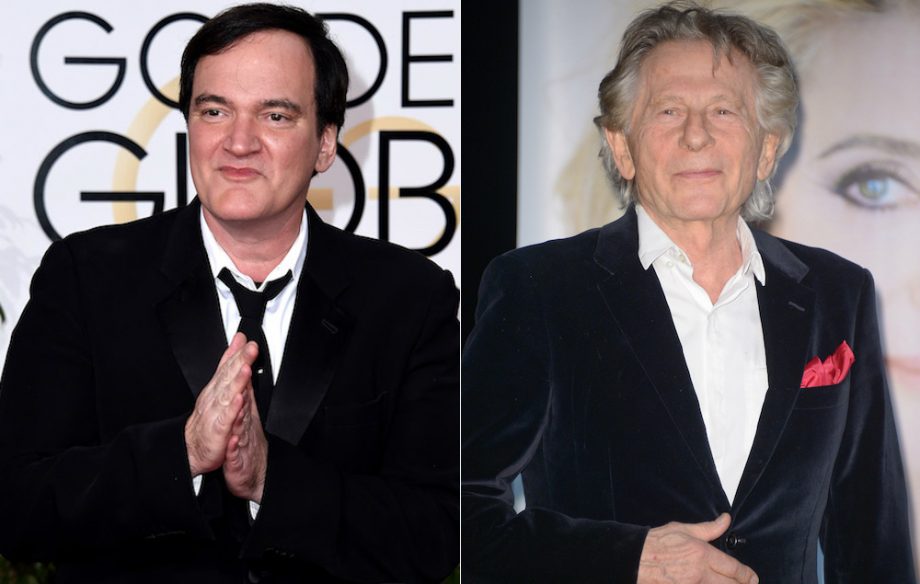
Quentin Tarantino may be trying to act like a woeful choirboy in the wake of the Harvey Weinstein allegations, but he seems all the more mendacious in the light of an old interview in which he claimed Roman Polanski’s 13-year-old rape victim “wanted to have it.”
Tarantino defended Polanski during a 2003 Howard Stern interview — which resurfaced on Jezebel — saying, “He didn’t rape a 13-year-old … he had sex with a minor. That’s not rape.”
When reminded by Stern sidekick Robin Quivers that Polanski’s victim was plied with drugs and alcohol, Tarantino said, “No, that was not the case at all. She wanted to have it [sex] and dated the guy … Look, she was down with this.”
Tarantino, who ruefully said of Weinstein, “I knew enough to do more than I did,” was accused by Uma Thurman of forcing her to do a car crash stunt in “Kill Bill” that left her injured, plus he spat in her face and choked her with a chain because he didn’t trust a trained actor to do it.
Tarantino called the Uma crash “one of the biggest regrets of my life.” It was met with horror in Hollywood.
Jessica Chastain tweeted, “I keep imagining Tarantino spitting in Uma’s face and strangling her with a chain…..How many images of women in media do we celebrate that showcase abuse? When did this become normalized ‘entertainment’?…. How can an actor feel safe when your director is strangling you?”
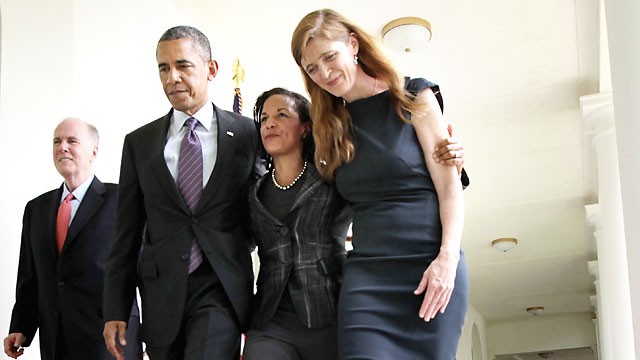
Samantha Power, the former U.S. ambassador to the United Nations, was ‘unmasking’ at such a rapid pace in the final months of the Obama administration that she averaged more than one request for every working day in 2016 – and even sought information in the days leading up to President Trump’s inauguration, multiple sources close to the matter told Fox News.
Two sources, who were not authorized to speak on the record, said the requests to identify Americans whose names surfaced in foreign intelligence reporting, known as unmasking, exceeded 260 last year. One source indicatedthis occurred in the final days of the Obama White House.
The details emerged ahead of an expected appearance by Power next month on Capitol Hill. She is one of several Obama administration officials facing congressional scrutiny for their role in seeking the identities of Trump associates in intelligence reports – but the interest in her actions is particularly high.
In a July 27 letter to Director of National Intelligence Dan Coats, House Intelligence Committee Chairman Devin Nunes, R-Calif., said the committee had learned “that one official, whose position had no apparent intelligence-related function, made hundreds of unmasking requests during the final year of the Obama Administration.”
The “official” is widely reported to be Power.
During a public congressional hearing earlier this year, Republican Rep. Trey Gowdy of South Carolina pressed former CIA director John Brennan on unmasking, without mentioning Power by name.
Gowdy: Do you recall any U.S. ambassadors asking that names be unmasked?
Brennan: I don’t know. Maybe it’s ringing a vague bell but I’m not — I could not answer with any confidence.
Gowdy continued, asking: On either January 19 or up till noon on January 20, did you make any unmasking requests?
Brennan: I do not believe I did.
Gowdy: So you did not make any requests on the last day that you were employed?
Brennan: No, I was not in the agency on the last day I was employed.
Brennan later corrected the record, confirming he was at CIA headquarters on January 20. “I went there to collect some final personal materials as well as to pay my last respects to a memorial wall. But I was there for a brief period of time and just to take care of some final — final things that were important to me,” Brennan said.
Former national security adviser Susan Rice (Reuters)
Three of the nation’s intelligence agencies received subpoenas in May explicitly naming three top Obama administration officials: Former national security adviser Susan Rice, Brennan and Power. Records were requested for Ben Rhodes, then-President Barack Obama’s adviser, but the documents were not the subject of a subpoena.
Asked for comment on Wednesday, a spokesman for Power had nothing further to add. But on Thursday, the spokesman provided this statement to Fox News:
“The anonymously sourced reports about Ambassador Power’s intelligence requests are false. Ambassador Power looks forward to engaging the bipartisan Committee in the appropriate classified forum.”
During congressional testimony since the unmasking controversy began, National Security Agency Director Adm. Mike Rogers has explained that unmasking is handled by the intelligence community in an independent review.
“We [the NSA] apply two criteria in response to their request: number one, you must make the request in writing. Number two, the request must be made on the basis of your official duties, not the fact that you just find this report really interesting and you’re just curious,” he said in June. “It has to tie to your job and finally, I said two but there’s a third criteria, and is the basis of the request must be that you need this identity to understand the intelligence you’re reading.”
Previous U.N. ambassadors have made unmasking requests, but Fox News was told they number in the low double digits.
Power has agreed to meet with the Senate and House intelligence committees as part of the Russia probe. She is expected before the House committee in a private, classified session in October.
Bret Baier is the Chief Political Anchor of Fox News Channel, and the Anchor & Executive Editor of “Special Report with Bret Baier.” His book, “Three Days in January: Dwight Eisenhower’s Final Mission,” (William Morrow) is on sale now.
Catherine Herridge is an award-winning Chief Intelligence correspondent for FOX News Channel (FNC) based in Washington, D.C. She covers intelligence, the Justice Department and the Department of Homeland Security. Herridge joined FNC in 1996 as a London-based correspondent.
Why are we debating this because the facts are we are losing money on illegal immigrants.
Introduction
A continually growing population of illegal aliens, along with the federal government’s ineffective efforts to secure our borders, present significant national security and public safety threats to the United States. They also have a severely negative impact on the nation’s taxpayers at the local, state, and national levels. Illegal immigration costs Americans billions of dollars each year. Illegal aliens are net consumers of taxpayer-funded services and the limited taxes paid by some segments of the illegal alien population are, in no way, significant enough to offset the growing financial burdens imposed on U.S. taxpayers by massive numbers of uninvited guests. This study examines the fiscal impact of illegal aliens as reflected in both federal and state budgets.
The Number of Illegal Immigrants in the US
Estimating the fiscal burden of illegal immigration on the U.S. taxpayer depends on the size and characteristics of the illegal alien population. FAIR defines “illegal alien” as anyone who entered the United States without authorization and anyone who unlawfully remains once his/her authorization has expired. Unfortunately, the U.S. government has no central database containing information on the citizenship status of everyone lawfully present in the United States. The overall problem of estimating the illegal alien population is further complicated by the fact that the majority of available sources on immigration status rely on self-reported data. Given that illegal aliens have a motive to lie about their immigration status, in order to avoid discovery, the accuracy of these statistics is dubious, at best. All of the foregoing issues make it very difficult to assess the current illegal alien population of the United States.
However, FAIR now estimates that there are approximately 12.5 million illegal alien residents. This number uses FAIR’s previous estimates but adjusts for suspected changes in levels of unlawful migration, based on information available from the Department of Homeland Security, data available from other federal and state government agencies, and other research studies completed by reliable think tanks, universities, and other research organizations.
The Cost of Illegal Immigration to the United States
At the federal, state, and local levels, taxpayers shell out approximately $134.9 billion to cover the costs incurred by the presence of more than 12.5 million illegal aliens, and about 4.2 million citizen children of illegal aliens. That amounts to a tax burden of approximately $8,075 per illegal alien family member and a total of $115,894,597,664. The total cost of illegal immigration to U.S. taxpayers is both staggering and crippling. In 2013, FAIR estimated the total cost to be approximately $113 billion. So, in under four years, the cost has risen nearly $3 billion. This is a disturbing and unsustainable trend. The sections below will break down and further explain these numbers at the federal, state, and local levels.
Total Governmental Expenditures on Illegal Aliens
Total Tax Contributions by Illegal Aliens
Total Economic Impact of Illegal Immigration
Federal
The Federal government spends a net amount of $45.8 billion on illegal aliens and their U.S.-born children. This amount includes expenditures for public education, medical care, justice enforcement initiatives, welfare programs and other miscellaneous costs. It also factors in the meager amount illegal aliens pay to the federal government in income, social security, Medicare and excise taxes.
FEDERAL SPENDING
The approximately $46 billion in federal expenditures attributable to illegal aliens is staggering. Assuming an illegal alien population of approximately 12.5 million illegal aliens and 4.2 million U.S.-born children of illegal aliens, that amounts to roughly $2,746 per illegal alien, per year. For the sake of comparison, the average American college student receives only $4,800 in federal student loans each year.
FAIR maintains that every concerned American citizen should be asking our government why, in a time of increasing costs and shrinking resources, is it spending such large amounts of money on individuals who have no right, nor authorization, to be in the United States? This is an especially important question in view of the fact that the illegal alien beneficiaries of American taxpayer largess offset very little of the enormous costs of their presence by the payment of taxes. Meanwhile, average Americans pay approximately 30% of their income in taxes.
Taxes collected from illegal aliens offset fiscal outlays and, therefore must be included in any examination of the cost of illegal immigration. However, illegal alien apologists frequently cite the allegedly large tax payments made by illegal aliens as a justification for their unlawful presence, and as a basis for offering them permanent legal status through a new amnesty, similar to the one enacted in 1986. That argument is nothing more than a red herring.
FAIR believes that most studies grossly overestimate both the taxes actually collected from illegal aliens and, more importantly, the amount of taxes actually paid by illegal aliens (i.e., the amount of money collected from illegal aliens and actually kept by the federal government). This belief is based on a number of factors: Since the 1990’s, the United States has focused on apprehending and removing criminal aliens. The majority of illegal aliens seeking employment in the United States have lived in an environment where they have little fear of deportation, even if discovered. This has created an environment where most illegal aliens are both able and willing to file tax returns. Because the vast majority of illegal aliens hold low-paying jobs, those who are subject to wage deductions actually wind up receiving a complete refund of all taxes paid, plus net payments made on the basis of tax credits.
As a result, illegal aliens actually profit from filing a tax return and, therefore, have a strong interest in doing so.
Isn’t it great that Maryland will be celebrating this BLM Moment?
The school board approved the resolution on Thursday making it one of the first school districts in the state of Maryland to do so. On Monday, the first day, people were encouraged to wear all black.
FOX 5’s Anjali Hemphill visited Parkdale High School where she found lots of participation but also some opposition. Hemphill says some students watched a video called “The Talk,” when she visited on Monday. “The Talk” is an example of one of several films and books that are recommended by the teacher’s union for “Black Lives Matter Week of Action.”
Organizers say “Black Lives Matter Week of Action” is about encouraging conversation and reflection about social justice in schools. “We start this conversation in schools because for many people and for many students, this is community. This is where you learn and where you talk to your peers. Maybe your professors and advisor that are going to advise you later on in life. So school is the most appropriate place to have these conversations,” said Joshua Omolola, a Parkdale High School student.
Let’s Celebrate These Model Citizens.
Participation is not mandatory, only encouraged. Hemphill said she spoke to both students and teachers who are excited to incorporate this subject into a week that is already being spent celebrating Black History Month. Hemphill said she also spoke to a teacher who didn’t want to go on camera in fear of retaliation. The teacher, who is an African American woman, says she does not support “Black Lives Matter Week of Action” and is very concerned about this new resolution passed by the board.
“I’m uncomfortable because I don’t believe in their thirteen principles – and I’m an African American. But I don’t believe in their cause. I don’t particularly want to try and teach anybody about their thirteen principles because I don’t believe in their thirteen principles. I’m also a parent, and my children go to Prince George’s County Public School, and I don’t want a teacher trying to teach my children about “Black Lives Matter,” said the unnamed teacher.
“I haven’t had a kid to walk out of my classroom. Only kid I’ve had – we’ve had discussions, and we’ve had heated discussions in the class. For some reason the students that are in this school are really – I guess because it’s so diverse – they are really good with respecting each other’s opinions,” said Neville Adams, and English and student government teacher at Parkdale.
Hemphill said she asked the board if they would allow other activist groups to have a “Week of Action” in their schools. The board said they would consider other ideas that encourage tolerance, equity and social justice.
We are losing money because of loopholes which is legal. Why not let them bring the money back and pay the same taxes they are paying overseas.
This article was first published in June of 2014
More than 70 percent of Fortune 500 companies maintain subsidiaries in offshore tax havens, according to a new report by the U.S. Public Interest Research Group Education Fund and Citizens for Tax Justice.
The consumer groups say tax loopholes in the U.S. encourage the companies to use the tax havens. Together, the report says, the companies sent $2 trillion offshore for tax purposes in 2013.
Exploitation of the loopholes is perfectly legal. But it results in a giant loss of federal tax revenue each year, according to the report. Fifty-five companies disclose the amount they would expect to pay in U.S. taxes if they didn’t report profits offshore for tax purposes: a total of $147.5 billion, “equal to the entire state budgets of California, Virginia, and Indiana combined,” says the report. “The average tax rate the 55 companies currently pay to other countries on this income is a mere 6.7 percent, implying that most of it is booked to tax havens.”
The conservative Tax Foundation attacked the report saying that it cherry-picks a small sample of the Fortune 500 corporations, 55 of them, producing unreliable results. According to the Foundation, in general, corporations actually paid an effective rate of about 27 percent on their foreign income. A spokesman said the report provides “a misleading picture of the tax burden corporations pay overseas.”
Co-author of the report, Dan Smith of U.S. PIRG Education Fund, disagrees.
“Our tax code is broken, and it’s hurting the public. We simply shouldn’t allow companies that use American roads, and benefit from America’s education system and large consumer market, to take a free ride at the expense of the rest of us,” says Smith.
Findings in the report include:
Nike: $6.7 billion booked offshore, on which it would otherwise owe $2.2 billion in U.S. taxes. “That means they pay a mere 2.2 percent tax rate on those offshore profits, suggesting nearly all of the money is held by subsidiaries in tax havens,” reads the report.
Pfizer: $69 billion in profits booked offshore, the third highest among the Fortune 500. “The world’s largest drug maker, operates 128 subsidiaries in tax havens,” according to the report.
The Tax Foundation pointed out “almost every country on the planet is a tax haven compared to the United States.” According to the foundation’s review of IRS data, “U.S. multinationals paid $128 billion in foreign income taxes on $470 billion in reported taxable income in 2010. This is an effective tax rate of 27.2 percent.”