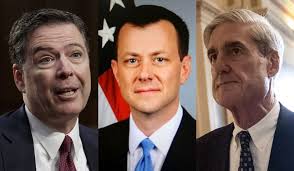
The Office of the Special Counsel deleted text messages from the iPhone of fired FBI agent Peter Strzok before turning it over to the Department of Justice Office of the Inspector General (OIG), according to a report released by the federal watchdog.
On Thursday, the Justice Department’s inspector general released a report stating thousands of text messages exchanged between Strzok and FBI attorney Lisa Page could not be recovered after Mueller’s team wiped clean the phones it had issued them.
So Mueller’s team wiped ALL of the data off of Peter Strzok’s iPhone after determining “it contained no substantive text messages.” Given what we know about Strzok, this smells like quite the coverup. Time for Congress to step in?
“SCO’s Records Officer told the OIG that as part of the office’s records retention procedure, the officer reviewed Strzok’s DOJ issued iPhone after he returned it to the SCO and determined it contained no substantive text messages,” the watchdog report reads. As Conservative Review national security reporter Jordan Schachtel first discovered, the OIG said Strzok’s cell phone was “reset to factory settings,” deleting all data stored on the device.
The federal watchdog said in the report it found “no discernible patterns” about the content of thousands of messages the FBI was able to recover between Strzok and Page. Both have been part of Mueller’s investigation of possible collusion between the Trump campaign and Russia.
Strzok and Page testified before Congress this summer, and the former FBI agent admitted that he had not turned over all of his communications with Page to the Inspector General from his personal phone, even though their recovered conversations showed the two suggesting they move to apps like iMessage or Gmail. Strzok told outgoing Rep. Darrell Issa (R-CA) that it is a “safe assumption” that he sent messages to Page from his personal phone that were similar in nature to the widely-publicized messages attacking Trump supporters. He told House Judiciary Chairman Bob Goodlatte (R-VA) that he himself determined which messages on that phone were “relevant to FBI business” that the Inspector General could review.
At that time of their exchanges, the FBI was investigating whether former secretary of state and then-presidential candidate Hillary Clinton improperly used a private email account while she was Secretary of State. Strzok, a senior counterintelligence agent, was assigned to the case, as was Page. Reports claimed the two were romantically involved during this time. Strzok was ultimately fired after anti-Trump text messages between him and Page were discovered by the special counsel.
Thursday’s report said the FBI used special software to collect more than 20,000 text messages from the pair’s phones, but not all were sent between Strzok and Page. Investigators have already released some of the controversial texts, including a message from Strzok saying he would “stop” President Donald Trump from winning the election.
Missing text messages from the pair’s iPhones, though, continue to elude the FBI.
Early this year, the Office of the Inspector General contacted Verizon Wireless to determine if the carrier retains old text messages. Verizon said messages are retained for up to seven days after they are sent, and then erased. The missing messages in question were much older than a week by that time and Verizon no longer had them.
Flynn should have known better. He is a scumbag anyway with his Turkish connection.
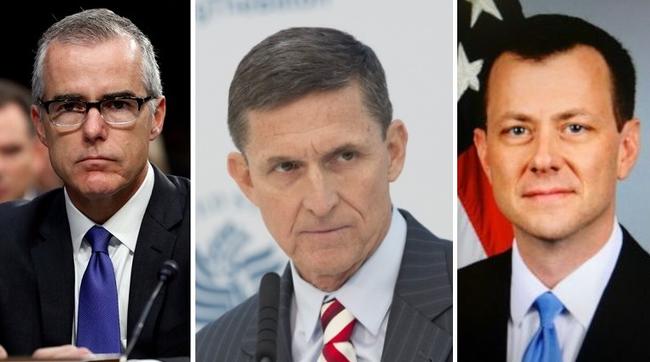
Andrew McCabe urged Michael Flynn to meet with FBI agents without White House attorneys present, according to a court filing submitted Tuesday in the special counsel’s probe.
McCabe and other FBI officials also decided not to provide a warning to Flynn about penalties regarding lying to the FBI.
Though Flynn’s lawyers are suggesting he was trapped into lying to the FBI, the new filing does not explain why the retired lieutenant general made false statements about his interactions with Russia’s ambassador
Just days into President Donald Trump’s tenure, then-FBI Deputy Director Andrew McCabe urged then-national security adviser Michael Flynn to meet with two FBI agents without White House lawyers present, claiming that a limited meeting would be the “quickest” way to have a conversation about Flynn’s discussions weeks earlier with Russia’s ambassador.
As if that scenario was not fraught with enough legal landmines, Flynn was also not warned by the two agents he met with about the penalties for lying to federal investigators. That’s because McCabe and other FBI officials decided before the fateful Jan. 24, 2017 meeting that “they wanted Flynn to be relaxed.” The officials “were concerned that giving the warnings might adversely affect the rapport” between Flynn and his FBI interlocutors.
Those revelations are tucked into a 178-page filing that Flynn’s lawyers submitted on Tuesday in the special counsel’s investigation.
While the filing contains new details about the White House interview, Flynn’s team does not provide an explanation for why the retired lieutenant general made false statements to the FBI agents, aside from saying that he “recognizes that his actions were wrong and he accepts full responsibility for them.”
While Flynn’s lawyers said in the filing that he is remorseful for lying to the FBI during that Jan. 24, 2017 meeting, the activities of McCabe and the FBI agents who interviewed Flynn are sure to generate outcry about overreach in the Russia investigation. Flynn’s supporters have noted that McCabe and one of the FBI agents, Peter Strzok, have run into ethical and legal problems of their own.
According to the filing, McCabe wrote in a memo just after arranging the White House visit that he suggested to Flynn that attorneys stay out of the interview in order to save time.
“I explained that I thought the quickest way to get this done was to have a conversation between [General Flynn] and the agents only,” McCabe wrote.
Flynn went along with McCabe’s suggestion, telling McCabe that involving White House lawyers “would not be necessary.” He agreed “to meet with the agents without any additional participants,” according to McCabe.
Less than two hours after that conversation, Peter Strzok, the FBI counterintelligence official leading the Russia probe, visited Flynn along with another FBI agent.
According to notes cited by Flynn’s lead attorney, Robert Kelner, one of the two FBI interviewers noted that Flynn was “relaxed and jocular” during their session. The agent said that Flynn appeared to treat the FBI agents as allies.
Seemingly acting on instructions from FBI brass, “the agents did not provide General Flynn with a warning of the penalties for making a false statement under 18 U.S.C. § 1001 before, during, or after the interview,” Kelner writes.
Flynn has since acknowledged giving false statements during that interview. He pleaded guilty on Dec. 1, 2017 to lying to the FBI agents about conversations he had in December 2016 with Russian ambassador Sergey Kislyak.
Flynn’s lawyers are seeking no jail time for the former lieutenant general, a request that is in line with prosecutors’ recommendation in a filing submitted on Dec. 4. Special counsel Robert Mueller in that filing cited Flynn’s “substantial assistance” in three separate investigations.
Kelner noted that Flynn, who was fired as national security adviser on Feb. 13, 2017, continued cooperating with the special counsel’s office “even when circumstances later came to light that prompted extensive public debate about the investigation of General Flynn.”
The lawyer appeared to be referencing the firestorm surrounding McCabe and Strzok.
McCabe was fired on March 16 after the FBI’s personnel office and Justice Department inspector general determined that he made misleading statements under oath about authorizing leaks to the media in October 2016 regarding an investigation into the Clinton Foundation.
Prosecutors are reportedly pursuing a case against McCabe.
Strzok was removed from the Mueller investigation in July 2017 and fired from the FBI on Aug. 13 of this year because of anti-Trump text messages he exchanged with his mistress, FBI lawyer Lisa Page.
Kelner noted that Flynn met with the special counsel’s office five times before entering his plea deal on Dec. 1, 2017. He had 14 more meeting with prosecutors after striking the agreement.
The filing did not address other legal issues Flynn has faced.
As part of his plea deal, Flynn acknowledged making false statements when he registered with the Justice Department as a foreign agent of Turkey for consulting work he did during the campaign. Flynn’s plea deal protected him from being prosecuted by the special counsel for his Turkish lobbying. Prosecutors in Virginia are investigating some of Flynn’s former business partners.
If you thought the Supreme Court would be Conservative, well think again.
The Supreme Court declined to review three cases relating to Republican efforts to defund Planned Parenthood at the state level Monday, over a vigorous dissent from Justice Clarence Thomas.
The dissent was significant because it indicates that Justice Brett Kavanaugh sided with the high court’s liberal wing to deny review of a lower court decision that favored the nation’s largest abortion provider.
“So what explains the Court’s refusal to do its job here?,” Thomas wrote. “I suspect it has something to do with the fact that some respondents in these cases are named ‘Planned Parenthood.’”
I guest Brett forgot what the damn liberals did to he and his family.
“Some tenuous connection to a politically fraught issue does not justify abdicating our judicial duty,” Thomas added. “If anything, neutrally applying the law is all the more important when political issues are in the background.”
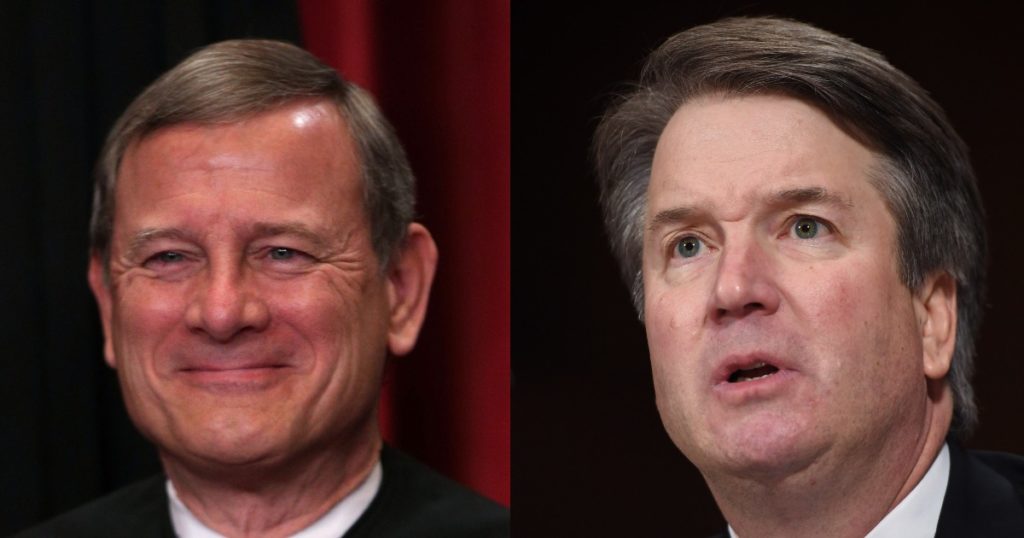
Justices Samuel Alito and Neil Gorsuch joined the Thomas dissent, meaning there were three votes in favor of taking the case. Since four votes are needed for the Supreme Court to take up a case, the opinion indicates that Chief Justice John Roberts and Kavanaugh joined with the four liberals to deny review.
This move could indicate that Roberts and Kavanaugh are loath to take take up an abortion-related question in the aftermath of Kavanaugh’s contentious confirmation. The Court’s new junior justice has generally kept a low profile since taking the bench in October.
Both of these phonies are liberals.
Justice Clarence Thomas participates in taking a new family photo with his fellow justices at the Supreme Court building in Washington, D.C. REUTERS/Jonathan Ernst
Monday’s cases arose when Republican state leaders in Louisiana and Kansas stripped Planned Parenthood of state Medicaid funds after a pro-life advocacy group presented evidence that the abortion-provider was harvesting and selling fetal materials. Planned Parenthood contests the accuracy of these claims.
Planned Parenthood and several unnamed female patients challenged the states’ move in federal court. The legal question in Monday’s cases was whether Medicaid recipients can challenge the disqualification of a provider under the Medicaid law. As such, it did not touch on abortion directly.
The 5th U.S. Circuit Court of Appeals sided with Planned Parenthood on that question in June 2017, prompting an appeal to the Supreme Court. That ruling is left in place now that the justices have refused to take the case.
Pro-life groups swiftly expressed their displeasure following Monday’s announcement.
“We are disappointed the Supreme Court declined to hear this case,” said Marjorie Dannenfelser, president of the Susan B. Anthony List. “The pro-life citizens of states like Kansas and Louisiana, through their elected representatives, have clearly expressed their will: they do not want Medicaid tax dollars used to prop up abortion businesses like Planned Parenthood.”
The Trump administration is currently formulating a new federal regulation called the Protect Life Rule which would forbid public funding of Planned Parenthood under Title X.
Former FBI Director James Comey revealed in closed-door testimony with House Republicans on Friday that he deliberately concealed an explosive memorandum about his one-on-one Oval Office meeting with President Trump in February 2017 from top Department of Justice officials.
The former FBI head also acknowledged that when the agency initiated its counterintelligence probe into possible collusion between Trump campaign officials and the Russian government in July 2016, investigators “didn’t know whether we had anything” and that “in fact, when I was fired as director [in May 2017], I still didn’t know whether there was anything to it.”
His remarks square with testimony this summer from former FBI lawyer Lisa Page, whose anti-Trump texts became a focus of House GOP oversight efforts. Page told Congress in a closed-door deposition that “even as far as May 2017” — more than nine months after the counterintelligence probe commenced — “we still couldn’t answer the question” as to whether Trump staff had improperly colluded with Russia.
Comey further testified on Friday that he and his aides were “all very concerned” about how the president had spoken of the probe into fired National Security Adviser Michael Flynn in a private Oval Office meeting, according to a 235-page transcript of his remarks released as a part of an agreement between House Republicans and Comey.
Former FBI Director James Comey testifies in closed-door interview on the Hill; chief intelligence correspondent Catherine Herridge reports.
The fired FBI director wrote in his memorandum that Trump had told him, “I hope you can let this go,” amid reports that Flynn had lied to the FBI and senior White House officials about his contacts with Russia’s government.
But despite that concern, Comey told Rep. Jim Jordan, R-Ohio, that he and his team made a “judgment call” not to tell then-Attorney General Jeff Sessions or his lieutenants about Trump’s comments, saying he thought Sessions would recuse himself “in a matter of days” from the Russia probe.
“We agreed that we ought to hold it very close, not brief the investigative team at this point and not go over and talk to the leadership of the Department of Justice, to hold onto it until we got a new deputy attorney general and they sorted out how they were going to supervise the Russia investigation,” Comey said.
Former National Security Adviser Michael Flynn, at center, pleaded guilty to making false statements to the FBI as part of Special Counsel Robert Mueller’s investigation. (AP)
Deputy Director Andrew McCabe, who was later fired for leaking a self-serving story to the press and lying about it to Comey and federal investigators, was among the brain trust Comey sat down with to discuss his options. The two were joined, Comey said, by then-FBI General Counsel James Baker and Comey’s chief of staff, James Rybicki.
Comey told lawmakers that others may have been present as well, including FBI Deputy Director David Bowdich (who was an associate deputy director at the time), National Security Branch Executive Director Carl Ghattas, and FBI counterintelligence head Bill Priestap, who recently announced he would leave the agency by year-end. Comey said that he did not believe anti-Trump FBI Agent Peter Strzok or former FBI lawyer Lisa Page were in the room.
Comey testified: “We believed that the Attorney General, Mr. Sessions, was on the cusp of recusing himself from anything related to Russia, so it didn’t make any sense to brief him on it, and that there was no deputy attorney general at that point.” (Sally Yates, a holdover from the Obama administration, was terminated by Trump in late January 2017 after she refused to defend the administration’s ban on travel from several Muslim-majority nations in court.)
“We agreed that we ought to hold it very close.”
— Former FBI Director James Comey
Sessions recused himself from Russia-related matters shortly afterward, in early March 2017 — a decision that Trump has since called a “terrible mistake,” although it was recommended by career Justice Department officials in part because Sessions had met with Russian dignitaries while assisting with the Trump campaign. But Jordan pressed Comey on why he decided not to tell the next-in-command at the DOJ.
Lawmakers release transcript of testimony from former FBI Director James Comey; reaction from Rep. Jim Jordan, Republican member of the House Judiciary and Oversight Committees.
“I don’t know who was No. 3 at that point,” Comey responded. “There was an acting — there was a U.S. Attorney acting as the deputy attorney general, who we knew would be in the seat only until Rod Rosenstein was confirmed,” he added, in an apparent reference to former Acting Deputy Attorney General Dana Boente, who served until Rosenstein took the job in April 2017.
Comey continued that “it made sense to hold onto it” because “we saw no investigative urgency.”
But unredacted sections of Comey’s other memoranda documenting his conversations with Trump apparently demonstrate that he later did inform Boente and other top DOJ officials about other sensitive matters concerning his conversations with the president.
In a memorandum documenting his phone conversation with Trump on March 30, 2017, about how to “lift the cloud” of the Russia investigation from the White House, Comey wrote, “I called the acting attorney general and relayed the substance of the above and said I was telling him so he could decide what guidance to give me, if any.”
In a call from the White House that day, Comey wrote that Trump had asked him “several times” to “find a way to get out” to the public that he was not actively under investigation as part of the ongoing federal probe into possible Russia collusion with his team. Comey assured Trump, and congressional leaders, that the president was not being investigated at the time.
Former FBI Director James Comey, with his attorney, David Kelley, right, speaks to reporters after a day of testimony before the House Judiciary and Oversight committees, on Capitol Hill in Washington, Friday, Dec. 7, 2018. (AP Photo/J. Scott Applewhite) (Associated Press)
House Republicans are set to have another opportunity to question Comey before they lose majority status when the new Congress is seated in January. The fired FBI director told reporters his return visit for more testimony will likely come the “week after next.”
Comey largely frustrated GOP lawmakers during Friday’s session, in large part because his lawyers urged him not to answer numerous questions. On Twitter after his testimony, Comey sharply criticized what he characterized as Republicans’ “desperate attempt to find anything that can be used to attack the institutions of justice investigating this president.”
But while Comey insisted in the interview that “we never investigated the Trump campaign for political purposes,” the transcript shows he claimed ignorance or memory lapses in response to questions concerning key details and events in the Russia investigation, which some GOP lawmakers continue to claim was improperly conducted.
The transcript reveals lawmakers’ frustration with his lack of specifics. Asked if he recalled who drafted the FBI’s “initiation document” for the July 2016 Russia investigation, Comey said, “I do not.” He again claimed not to know when asked about the involvement in that initiation of Peter Strzok, whose anti-Trump texts later got him removed from the special counsel’s probe.
When asked if the FBI had any evidence that anyone in the Trump campaign conspired to hack the DNC server, Comey gave a lengthy answer referring to Special Counsel Robert Mueller’s investigation as to why he couldn’t answer.
Early Sunday, Trump slammed Comey’s testimony repeatedly on Twitter, deriding him as “Leakin’ James Comey.”
On 245occasions, former FBI Director James Comey told House investigators he didn’t know, didn’t recall, or couldn’t remember things when asked. Opened investigations on 4 Americans (not 2) – didn’t know who signed off and didn’t know Christopher Steele. All lies!
Leakin’ James Comey must have set a record for who lied the most to Congress in one day. His Friday testimony was so untruthful! This whole deal is a Rigged Fraud headed up by dishonest people who would do anything so that I could not become President. They are now exposed!
But there was a time when Comey, by his own accounting, didn’t think of himself as the kind of person who would leak information behind the president’s back.
In a Jan. 28, 2017, dinner with Trump in the White House’s Green Room, Comey wrote in a since-released memorandum that he told the president, “I don’t do sneaky things, I don’t leak, I don’t do weasel moves.“
James Comey Admits FBI Was Still Probing ‘Pee’ Dossier Until Day He Was Fired
At the time James B. Comey was fired as FBI director, his agency was still attempting to corroborate claims made in the infamous, largely-discredited anti-Trump dossier, Comey admitted.
In testimony to the House Judiciary Committee on Friday, Comey described an effort “to try to replicate, either rule in or rule out, as much of that collection of reports that’s commonly now called the Steele dossier as possible, and that that work was ongoing when I was fired.” Trump dismissed Comey from the FBI on May 9, 2017.
A transcript of Comey’s testimony was released on Saturday. During one exchange with lawmakers, Comey said that FBI efforts to probe the dossier given to the agency by former British spy Christopher Steele started “sometime in ’16” almost immediately after Steele provided the charges.
The timing is instructive. In previous testimony, Comey admitted that he pushed back against a January 2017 request from President Donald Trump to possibly investigate the origins of the claims made inside the Steele dossier.
Comey’s latest testimony shows that even while he was cautioning Trump against ordering a probe of the dossier claims, Comey’s own FBI was quietly conducting an ongoing investigation into the wild content of that very dossier.
During prepared remarks for the Senate Select Committee on Intelligence, delivered on June 8, 2017, Comey related how he pushed back against a suggestion from Trump to investigate the dossier claims.
The former FBI chief stated that following a January 6 Oval Office meeting with Intelligence Community leaders, Comey “remained alone with the President Elect to brief him on some personally sensitive aspects of the information assembled during the assessment.”’
It is clear Comey was referring to the dossier since he writes the “salacious and unverified” material was about to be publicly reported by the news media. Four days after that briefing, the dossier was published by BuzzFeed.
In his statement summarizing his conversation with Trump, Comey refers to Russian prostitutes, a key component of the dossier:
He said he had nothing to do with Russia, had not been involved with hookers in Russia, and had always assumed he was being recorded when in Russia.
In a private White House dinner with Trump on January 27, Comey says the topic of the “salacious material” again came up and he reveals that Trump was considering asking the FBI to investigate the origins of the claims. Comey pushed back against that idea.
Comey writes:
During the dinner, the President returned to the salacious material I had briefed him about on January 6, and, as he had done previously, expressed his disgust for the allegations and strongly denied them. He said he was considering ordering me to investigate the alleged incident to prove it didn’t happen. I replied that he should give that careful thought because it might create a narrative that we were investigating him personally, which we weren’t, and because it was very difficult to prove a negative. He said he would think about it and asked me to think about it.
The Steele dossier was reportedly funded by Hillary Clinton’s 2016 presidential campaign and the Democratic National Committee (DNC) via the Perkins Coie law firm.
A House Intelligence Committee memo released last February documented that as FBI director, Comey signed three FISA applications to spy on former Trump adviser Carter Page with the dossier serving as part of the basis for the warrant requests.
Comey signed the applications without telling the FISA court that the dossier was financed by Trump’s primary political opponents, the memo related.
“Neither the initial application in October 2016, nor any of the renewals, disclose or reference the role of the DNC, Clinton campaign, or any party/campaign in funding Steele’s efforts, even though the political origins of the Steele dossier were then known to senior and FBI officials,” the memo states.
The GOP memo also relates that after Steele was terminated months earlier as an FBI source a “source validation report conducted by an independent unit within FBI assessed Steele’s reporting as only minimally corroborated.” Still, Comey saw fit, according to the Republican and Democrat memos, to utilize the dossier in the FISA documents. He also briefed Trump and then-President Barack Obama on the dossier contents.
When he was appointed a Justice Department special counsel in May 2017, Robert Mueller was assigned the task of determining whether presidential candidate Donald Trump and/or members of the Trump campaign conspired with Russia to elect Trump president. New court filings Friday by Mueller and federal prosecutors in New York City leave this central question unanswered.
In 19 months, the Mueller probe has expanded again and again, taking an ever-widening look over many years at a broad range of activities by people associated with the Trump campaign or who had business dealings with Trump long before he moved into the White House.
Some crimes that people have been charged with or even admitted to have nothing to do with Trump, but rather pertain to wrongdoing or alleged wrongdoing by people with some association with him.
Unquestionably, this is a fishing expedition that has caught some fish. Mueller and his team of prosecutors have secured indictments, convictions and guilty pleas from people with some affiliation with Trump – but as yet, there is no “smoking gun” saying there was Trump-Russia collusion to defeat Hillary Clinton and install Trump in the Oval Office.
Will this evidence turn up in the future? The only honest answer those of us without inside information can give is that we don’t know.
Much of Mueller’s activities are cloaked in secrecy. Many of the documents he has filed in court have large amounts of information blacked out – “redacted” in legal terminology – so we have no idea what they say.
But we have to wonder: How long will this investigation go on? How wide a net will it cast? How far back in time will it go? How many more millions of dollars will it cost American taxpayers?
And finally, is the cloud the Mueller probe is casting over the Trump administration benefitting our nation, or simply weakening the president and preventing him from accomplishing the many things the American people elected him to do on our behalf?
The latest chapter in this long saga took place Friday when a sentencing memorandum was filed in U.S. District Court New York City by the Justice Department dealing with former Trump personal attorney Michael Cohen.
Cohen earlier pleaded guilty to multiple counts of business and tax fraud. He also pleaded guilty to making an excessive contribution to the Trump campaign and to making false statements to Congress regarding unsuccessful efforts to build a Trump Tower in Moscow.
The sentencing memo for Cohen shows there is clearly no love lost between him and the Justice Department, despite his pleading guilty to the charges against him.
The Cohen memo was in sharp contrast to the sentencing recommendation that Mueller recently filed in the government’s case against retired Army Lt. Gen. Michael Flynn, who served for 24 days as President Trump’s national security adviser. That recommended little or no jail time.
But the U.S. attorney in the Southern District of New York asked the court to impose a “substantial term of imprisonment” against Cohen of about four to five years.
The recommendation reflects what the Justice Department document calls Cohen’s “extensive, deliberate, and serious criminal conduct.”
The Probation Department is recommending a sentence of 42 months in prison and a $100,000 fine for Cohen.
The sentencing memorandum castigates Cohen, saying he was “motivated by personal greed, and repeatedly used his power and influence for deceptive ends.”
The four crimes Cohen pleaded guilty to – tax evasion, false statements to a financial institution, illegal campaign contributions, and false statements to Congress – were “marked by a pattern of deception that permeated his professional life (and was evidently hidden from the friends and family members who wrote on his behalf).”
In fact, Cohen’s criminal conduct, according to the sentencing memo, strikes “at several pillars of our society and system of government: the payment of taxes; transparent and fair elections; and truthfulness before government and in business.”
And finally, is the cloud the Mueller probe is casting over the Trump administration benefitting our nation, or simply weakening the president and preventing him from accomplishing the many things the American people elected him to do on our behalf?
The Justice Department accuses Cohen of seeking the “extraordinary leniency” of no prison sentence based on “his rose-colored view of the seriousness of the crimes” and his providing “certain information to law enforcement.”
But the department downplays Cohen’s cooperation with Special Counsel Mueller, calling Cohen’s claim “overstated” and “incomplete.”
In fact, the department says Cohen is not getting official recognition as a “cooperating witness.” The sentencing memo says Cohen’s providing of some information should be a “mitigating factor” but that he “repeatedly declined to provide full information about the scope of any additional criminal conduct in which he may have engaged or had knowledge.”
This throws doubt on the idea that Cohen has secretly provided some kind of undisclosed information or evidence to the special counsel that bears on what is supposed to be the focus of Mueller’s investigation: whether there was any unlawful collusion between the Trump campaign and Russian officials to change the outcome of the 2016 election.
Another interesting note in the sentencing recommendation is a statement by the Justice Department that indicates that Cohen greatly exaggerated his access to Trump. The department says that Cohen “secured a substantial amount of consulting business for himself” by claiming he had “unique insights and access to Individual-1,” referring to Trump.
But while Cohen made millions of dollars from these consulting contracts, “his promises of insight and access proved essentially hollow” and he performed “minimal work,” according to the sentencing memo. It also says Cohen “used sophisticated tactics to conceal his misconduct.”
After a lengthy description of Cohen’s crimes, the Justice Department says that his conduct “underscores the need for a substantial period of incarceration as a means to promote respect for the law and to deter future abuses by other individuals seeking improperly to influence the electoral process, evade taxes, or lie to financial institutions.”
The department then spends eight pages explaining why the court should ignore Cohen’s request for a sentence of time served, with no additional jail time, because in essence, Cohen thinks “he is above the laws reflected in his crimes of conviction.”
Yet it cannot be emphasized enough that once again, as with prior documents filed by the Justice Department and the special counsel dealing with other defendants, there is no information in Cohen’s sentencing memorandum about the issue of possible Trump-Russia election collusion.
Perhaps there is such material in whatever information Cohen gave to the special counsel in his debriefing meetings. We can only guess.
There were also new developments Friday in a separate case involving former Trump Campaign Chairman Paul Manafort.
Mueller filed a document in U.S. District court in Washington outlining his claim that Manafort breached a plea agreement when he “told multiple discernible lies” to Mueller’s office and the FBI that were “not instances of mere memory lapses.”
Mueller says that Manafort met with the special counsel’s office 12 times and was called before a grand jury twice.
Large portions of the filing are redacted, but Mueller contends that Manafort lied about his interactions with Konstantin Kilimnik, a Russian-Ukrainian political consultant who worked with Manafort.
Mueller also contends that Manafort lied about: a wire transfer of $125,000 to a firm working for Manafort; information “pertinent to another Department of Justice investigation;” and “Manafort’s contact with Administration officials.”
Manafort contends he has told the truth to Mueller.
Once again, with the extensive redactions, there is no way to tell whether any of these alleged false statements had anything to do with the Russian election collusion investigation. If Manafort contests the government’s claims, as is likely, then the judge will hold a hearing where the special counsel says it will “prove the false statements.”
If the judges in each of these cases adopt the government’s recommendations and claims, Cohen will be facing a handful of years in prison and Manafort, 69, could spend the rest of his life in prison.
Manafort was convicted in August of eight counts of financial fraud and was facing another trial on additional felony charges when he agreed in September to plead guilty to two more felonies and to cooperate with Mueller’s office.
What comes next? We simply don’t know, because Mueller has not lifted the curtain hiding much of his activities. But as of now, from what we know on the public record, Mueller has failed to prove the Trump-Russia collusion that he was appointed to investigate 19 months ago.
Trump should have investigated Hillary and all the corrupt Democrats. Don’t play nice with demons is my motto.
0:55
Sunday on CBS’s “Face the Nation,” the likely next chairman of the House Intelligence Committee, Rep. Adam Schiff (D-CA) said President Donald Trump might “face the real prospect of jail time” in light of charges against his personal attorney, Michael Cohen for illegal payments during the 2016 presidential campaign.
Schiff said, “There’s a very real prospect that on the day Donald Trump leaves office, the Justice Department may indict him, that he may be the first president in quite some time to face the real prospect of jail time. We have been discussing the issue of pardons the president may offer to people or dangle in front of people. The bigger pardon question may come down the road, as the next president has to determine whether to pardon Donald Trump.”